Ch.9 - Molecular Geometry and Bonding Theories
Brown - Chemistry: The Central Science 14th Edition
Brown14th EditionChemistry: The Central ScienceISBN: 9780134414232당신이 사용하는 게 아니라요?교과서 변경
9장, 문제 53

Shown here are three pairs of hybrid orbitals, with each set at a characteristic angle. For each pair, determine the type of hybridization, if any, that could lead to hybrid orbitals at the specified angle. (a)
Three pairs of hybrid orbitals at angles 45°, 80°, 120°, and 180° for hybridization analysis.


(b)


(c)

검증된 단계별 안내
1
Identify the characteristic angles for each pair of hybrid orbitals: 45°, 80°, 120°, and 180°.
Recall the common hybridization angles: sp (180°), sp2 (120°), sp3 (109.5°), and other less common hybridizations.
Determine the hybridization for the 45° angle. Note that this angle is not typical for standard hybrid orbitals, suggesting no common hybridization.
Determine the hybridization for the 80° angle. This angle is also not typical for standard hybrid orbitals, suggesting no common hybridization.
Determine the hybridization for the 120° and 180° angles. The 120° angle corresponds to sp2 hybridization, and the 180° angle corresponds to sp hybridization.

비슷한 문제에 대한 검증된 영상 답변:

이 영상 해법은 위 문제에 도움이 된다고 튜터들이 추천한 것입니다.
영상 길이:
58s

주요 개념

질문에 올바르게 답하기 위해 반드시 이해해야 하는 핵심 개념들은 다음과 같습니다.

Hybridization

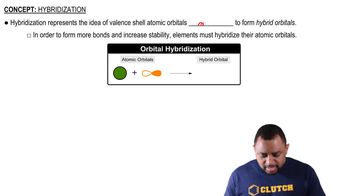
Hybridization is the process of combining atomic orbitals to form new hybrid orbitals that can accommodate bonding in molecules. The type of hybridization depends on the number of atomic orbitals mixed and the geometry of the resulting hybrid orbitals, which influences bond angles and molecular shape.
추천 영상:

Bond Angles

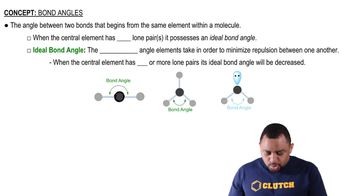
Bond angles are the angles formed between adjacent bonds in a molecule, which are determined by the arrangement of hybrid orbitals. Different types of hybridization lead to characteristic bond angles, such as 180° for sp hybridization, 120° for sp², and 109.5° for sp³, reflecting the geometry of the molecule.
추천 영상:

Types of Hybridization

There are several types of hybridization, including sp, sp², and sp³, each corresponding to different geometrical arrangements. For example, sp hybridization results in linear geometry with a 180° bond angle, while sp² leads to trigonal planar geometry with 120° angles, and sp³ results in tetrahedral geometry with 109.5° angles.
추천 영상: