
Ch.9 - Molecular Geometry and Bonding Theories
Brown - Chemistry: The Central Science 14th Edition
Brown14th EditionChemistry: The Central ScienceISBN: 9780134414232당신이 사용하는 게 아니라요?교과서 변경
9장, 문제 112a

The energy-level diagram in Figure 9.36 shows that the sideways overlap of a pair of p orbitals produces two molecular orbitals, one bonding and one antibonding. In ethylene there is a pair of electrons in the bonding π orbital between the two carbons. Absorption of a photon of the appropriate wavelength can result in promotion of one of the bonding electrons from the p2p to the p*2p molecular orbital. (a) Assuming this electronic transition corresponds to the HOMO-LUMO transition, what is the HOMO in ethylene?
Energy-level diagram showing bonding and antibonding molecular orbitals from 1s orbitals.

검증된 단계별 안내
1
Identify the molecular orbitals involved in the bonding of ethylene. In ethylene, the bonding involves the overlap of p orbitals to form π (pi) molecular orbitals.
Understand the concept of HOMO (Highest Occupied Molecular Orbital) and LUMO (Lowest Unoccupied Molecular Orbital). The HOMO is the highest energy orbital that contains electrons, while the LUMO is the lowest energy orbital that does not contain electrons.
In the context of ethylene, the HOMO is the π bonding orbital, which is the highest energy orbital that is occupied by electrons.
The LUMO in ethylene is the π* (pi star) antibonding orbital, which is the lowest energy orbital that is unoccupied.
Therefore, the HOMO in ethylene is the π bonding orbital formed by the sideways overlap of the p orbitals on the two carbon atoms.

비슷한 문제에 대한 검증된 영상 답변:

이 영상 해법은 위 문제에 도움이 된다고 튜터들이 추천한 것입니다.
영상 길이:
1m

주요 개념

질문에 올바르게 답하기 위해 반드시 이해해야 하는 핵심 개념들은 다음과 같습니다.

Molecular Orbitals

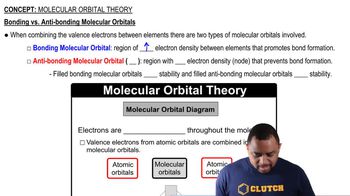
Molecular orbitals (MOs) are formed when atomic orbitals combine during the bonding process. In ethylene, the sideways overlap of p orbitals creates bonding (π) and antibonding (π*) molecular orbitals. The bonding orbital is lower in energy and stabilizes the molecule, while the antibonding orbital is higher in energy and can destabilize it if occupied.
추천 영상:
가이드 코스
03:06
Molecular Orbital Theory

HOMO and LUMO

The Highest Occupied Molecular Orbital (HOMO) is the molecular orbital that contains the highest energy electrons in a molecule, while the Lowest Unoccupied Molecular Orbital (LUMO) is the lowest energy orbital that is unoccupied. In the context of ethylene, the transition of an electron from the HOMO to the LUMO upon photon absorption is crucial for understanding its electronic properties and reactivity.

Electronic Transitions

Electronic transitions occur when an electron absorbs energy, typically from a photon, and moves from a lower energy state (HOMO) to a higher energy state (LUMO). In ethylene, this transition is significant for understanding its absorption spectrum and the wavelengths of light it can absorb, which is essential for applications in photochemistry and materials science.
추천 영상:
가이드 코스
00:53
Electron Configurations Of Transition Metals Example
관련 실천
교과서 질문

(c) It turns out that the difference in energies between the valence atomic orbitals of H and F are sufficiently different that we can neglect the interaction of the 1s orbital of hydrogen with the 2s orbital of fluorine.

The 1s orbital of hydrogen will mix only with one 2p orbital of fluorine. Draw pictures showing the proper orientation of all three 2p orbitals on F interacting with a 1s orbital on H. Which of the 2p orbitals can actually make a bond with a 1s orbital, assuming that the atoms lie on the z-axis?

1
views
교과서 질문

The energy-level diagram in Figure 9.36 shows that the sideways overlap of a pair of p orbitals produces two molecular orbitals, one bonding and one antibonding. In ethylene there is a pair of electrons in the bonding π orbital between the two carbons. Absorption of a photon of the appropriate wavelength can result in promotion of one of the bonding electrons from the p2p to the p*2p molecular orbital. (b) Assuming this electronic transition corresponds to the HOMO-LUMO transition, what is the LUMO in ethylene?

485
views
교과서 질문

(b) How many of the MOs from part (a) would be occupied by electrons?

1
views
교과서 질문

Carbon monoxide, CO, is isoelectronic to N2. (d) Would you expect the p2p MOs of CO to have equal atomic orbital contributions from the C and O atoms? If not, which atom would have the greater contribution?

1217
views
교과서 질문

The energy-level diagram in Figure 9.36 shows that the sideways overlap of a pair of p orbitals produces two molecular orbitals, one bonding and one antibonding. In ethylene there is a pair of electrons in the bonding π orbital between the two carbons. Absorption of a photon of the appropriate wavelength can result in promotion of one of the bonding electrons from the p2p to the p*2p molecular orbital. (c) Is the C¬C bond in ethylene stronger or weaker in the excited state than in the ground state? Why?

510
views