Ch.9 - Molecular Geometry and Bonding Theories
Brown - Chemistry: The Central Science 14th Edition
Brown14th EditionChemistry: The Central ScienceISBN: 9780134414232당신이 사용하는 게 아니라요?교과서 변경
9장, 문제 6b

The orbital diagram that follows presents the final step in the formation of hybrid orbitals by a silicon atom. (b) What type of hybrid orbital is produced in this hybridization?

검증된 단계별 안내
1
Step 1: Look at the orbital diagram provided. The orbital diagram should show the distribution of electrons in the atomic orbitals of the silicon atom after hybridization.
Step 2: Count the number of orbitals that are involved in the hybridization. The number of atomic orbitals that are involved in the hybridization process will determine the type of hybrid orbitals formed.
Step 3: Identify the type of hybridization. If there are four orbitals involved (one 2s and three 2p), the hybridization is sp3. If there are three orbitals involved (one 2s and two 2p), the hybridization is sp2. If there are two orbitals involved (one 2s and one 2p), the hybridization is sp.
Step 4: The type of hybrid orbital produced corresponds to the type of hybridization. For example, sp3 hybridization produces sp3 hybrid orbitals, sp2 hybridization produces sp2 hybrid orbitals, and sp hybridization produces sp hybrid orbitals.
Step 5: Remember that the type of hybridization can also give you information about the geometry of the molecule. For example, sp3 hybridization corresponds to a tetrahedral geometry, sp2 hybridization corresponds to a trigonal planar geometry, and sp hybridization corresponds to a linear geometry.

비슷한 문제에 대한 검증된 영상 답변:

이 영상 해법은 위 문제에 도움이 된다고 튜터들이 추천한 것입니다.
영상 길이:
48s

주요 개념

질문에 올바르게 답하기 위해 반드시 이해해야 하는 핵심 개념들은 다음과 같습니다.

Hybridization

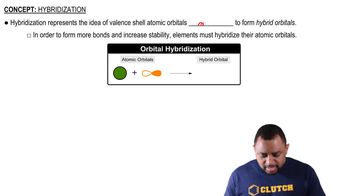
Hybridization is a concept in chemistry that describes the mixing of atomic orbitals to form new hybrid orbitals. These hybrid orbitals have different energies and shapes compared to the original atomic orbitals, allowing for the formation of more stable molecular structures. In the case of silicon, hybridization typically involves the combination of its 3s and 3p orbitals.
추천 영상:

Types of Hybrid Orbitals

There are several types of hybrid orbitals, including sp, sp2, and sp3, which correspond to the number of atomic orbitals mixed. For example, sp hybridization involves one s and one p orbital, resulting in two equivalent sp orbitals, while sp3 hybridization involves one s and three p orbitals, resulting in four equivalent sp3 orbitals. The type of hybridization affects the geometry and bonding properties of the molecule.
추천 영상:

Silicon's Hybridization

Silicon typically undergoes sp3 hybridization when forming four equivalent bonds, as seen in compounds like silicon tetrafluoride (SiF4). In this process, one 3s and three 3p orbitals combine to create four sp3 hybrid orbitals, which are oriented tetrahedrally. Understanding this hybridization is crucial for predicting the molecular geometry and reactivity of silicon-containing compounds.
추천 영상: