Ch.9 - Molecular Geometry and Bonding Theories
Brown - Chemistry: The Central Science 14th Edition
Brown14th EditionChemistry: The Central ScienceISBN: 9780134414232당신이 사용하는 게 아니라요?교과서 변경
9장, 문제 35

What is the distinction between a bond dipole and a molecular dipole moment?

검증된 단계별 안내
1
Step 1: Understand that a bond dipole refers to the separation of electrical charge between two atoms in a chemical bond due to differences in electronegativity.
Step 2: Recognize that a bond dipole is a vector quantity, having both magnitude and direction, pointing from the less electronegative atom to the more electronegative atom.
Step 3: Learn that a molecular dipole moment is the vector sum of all individual bond dipoles in a molecule, taking into account the geometry of the molecule.
Step 4: Note that a molecule can have polar bonds (bond dipoles) but still be nonpolar overall if the bond dipoles cancel each other out due to the molecular geometry.
Step 5: Understand that the molecular dipole moment is a measure of the overall polarity of a molecule, which affects properties like solubility and boiling point.

주요 개념

질문에 올바르게 답하기 위해 반드시 이해해야 하는 핵심 개념들은 다음과 같습니다.

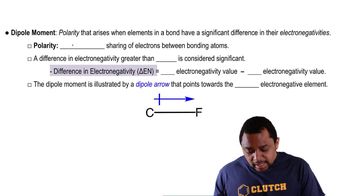
Bond Dipole

A bond dipole occurs in a covalent bond between two atoms with differing electronegativities. The atom with higher electronegativity attracts the shared electrons more strongly, creating a partial negative charge (δ-) on that atom and a partial positive charge (δ+) on the other. This separation of charge results in a dipole moment, which is a vector quantity pointing from the positive to the negative end of the bond.
추천 영상:

Molecular Dipole Moment

The molecular dipole moment is a vector sum of all the individual bond dipoles in a molecule. It reflects the overall polarity of the molecule, taking into account both the magnitude and direction of each bond dipole. A molecule can have a net dipole moment if its bond dipoles do not cancel out, indicating that the molecule has a positive and negative end, which affects its interactions with other molecules.
추천 영상:

Electronegativity

Electronegativity is a measure of an atom's ability to attract and hold onto electrons in a chemical bond. It plays a crucial role in determining the polarity of bonds; atoms with higher electronegativity will pull electron density towards themselves, leading to the formation of bond dipoles. Understanding electronegativity helps predict the behavior of molecules in terms of polarity and reactivity.
추천 영상:
가이드 코스
02:10
Electronegativity Trends