
Ch.10 - Gases
Brown - Chemistry: The Central Science 15th Edition
Brown15th EditionChemistry: The Central ScienceISBN: 9780137542970당신이 사용하는 게 아니라요?교과서 변경
10장, 문제 41

A 35.1 g sample of solid CO2 (dry ice) is added to a container at a temperature of 100 K with a volume of 4.0 L. If the container is evacuated (all of the gas is removed), sealed, and then allowed to warm to room temperature (𝑇=298 K) so that all of the solid CO2 is converted to a gas, what is the pressure inside the container?

검증된 단계별 안내
1
Step 1: First, we need to calculate the number of moles of CO2. We can do this by using the molar mass of CO2, which is 44.01 g/mol. The formula to calculate the number of moles is: n = mass / molar mass.
Step 2: Next, we need to convert the volume of the container from liters to cubic meters, as the ideal gas law requires the volume to be in cubic meters. We can do this by using the conversion factor 1 L = 0.001 m^3.
Step 3: Now, we can use the ideal gas law to calculate the pressure. The ideal gas law is: P = nRT / V, where P is the pressure, n is the number of moles, R is the ideal gas constant (8.314 J/(mol·K)), T is the temperature in Kelvin, and V is the volume in cubic meters.
Step 4: Substitute the values of n, R, T, and V into the ideal gas law equation to calculate the pressure.
Step 5: The pressure will be in Pascals (Pa). If you need the pressure in another unit, such as atmospheres or torr, you will need to convert it using the appropriate conversion factor.

비슷한 문제에 대한 검증된 영상 답변:

이 영상 해법은 위 문제에 도움이 된다고 튜터들이 추천한 것입니다.
영상 길이:
4m

주요 개념

질문에 올바르게 답하기 위해 반드시 이해해야 하는 핵심 개념들은 다음과 같습니다.

Ideal Gas Law

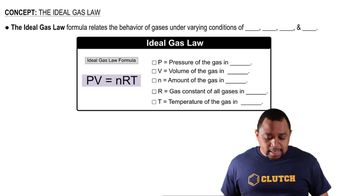
The Ideal Gas Law is a fundamental equation in chemistry that relates the pressure, volume, temperature, and number of moles of a gas. It is expressed as PV = nRT, where P is pressure, V is volume, n is the number of moles, R is the ideal gas constant, and T is temperature in Kelvin. This law is essential for calculating the pressure of gases under various conditions, particularly when transitioning from solid to gas states.
추천 영상:
가이드 코스
01:15
Ideal Gas Law Formula

Phase Change

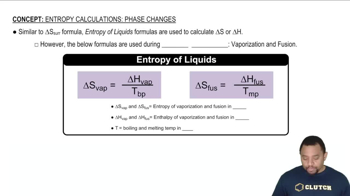
Phase change refers to the transformation of a substance from one state of matter to another, such as from solid to gas. In this scenario, dry ice (solid CO2) sublimates directly into gas when heated. Understanding phase changes is crucial for predicting how substances behave under different temperature and pressure conditions, especially in thermodynamic processes.
추천 영상:
가이드 코스
01:46
Entropy in Phase Changes

Molar Mass and Moles Calculation

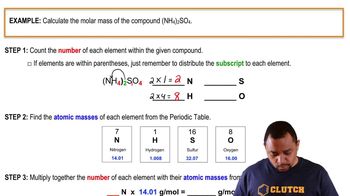
Molar mass is the mass of one mole of a substance, typically expressed in grams per mole. For CO2, the molar mass is approximately 44.01 g/mol. To find the number of moles in a given mass, the formula n = mass/molar mass is used. This calculation is vital for determining the amount of gas produced from the sublimation of dry ice, which is necessary for applying the Ideal Gas Law.
추천 영상:
가이드 코스
03:12
Molar Mass Calculation Example