
Ch.10 - Gases
Brown - Chemistry: The Central Science 15th Edition
Brown15th EditionChemistry: The Central ScienceISBN: 9780137542970당신이 사용하는 게 아니라요?교과서 변경
10장, 문제 14b

(b) Which units are appropriate for expressing atmospheric pressures, N, Pa, atm, kg/m2?

검증된 단계별 안내
1
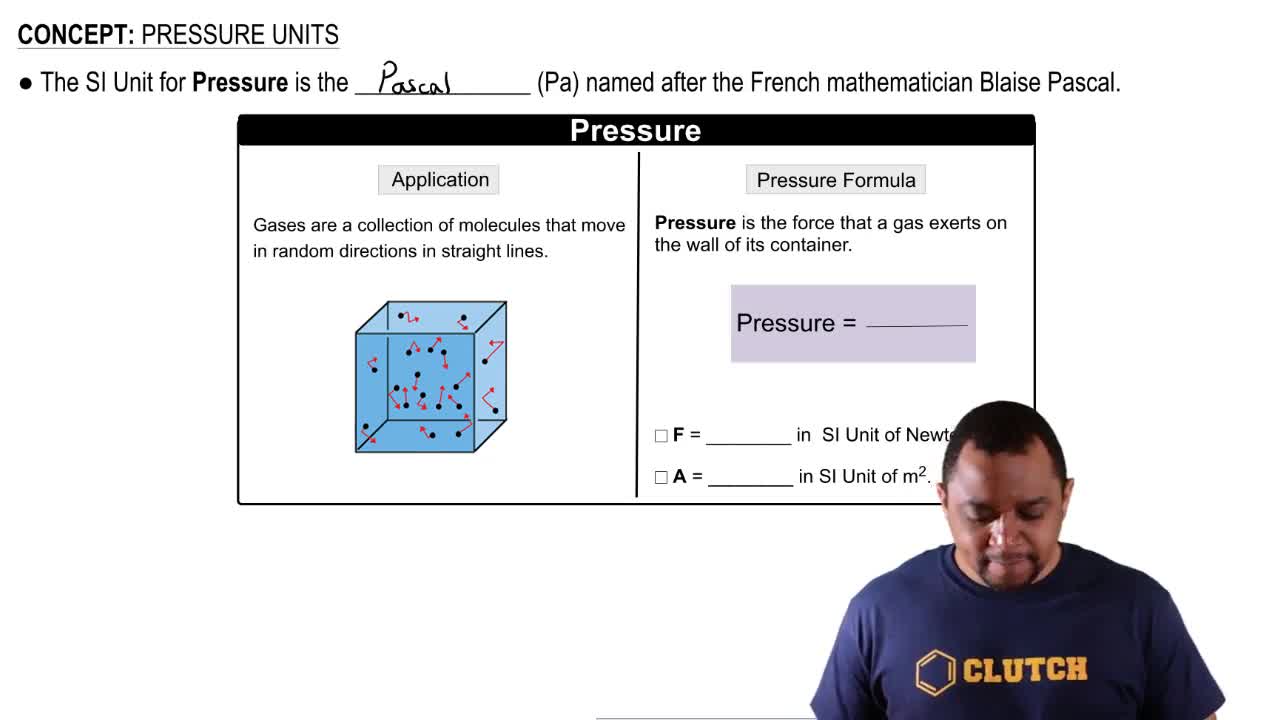
Identify the units commonly used for measuring pressure. Pressure is defined as force per unit area.
Understand the units given in the question: N (Newton), Pa (Pascal), atm (atmosphere), and kg/m^2 (kilograms per square meter).
Recognize that Newton (N) is a unit of force, not pressure. Therefore, it is not appropriate for expressing atmospheric pressures.
Pascal (Pa) is the SI unit of pressure and is defined as one newton per square meter. It is suitable for expressing atmospheric pressures.
Atmosphere (atm) is a unit specifically used to measure atmospheric pressure, thus it is also appropriate.

비슷한 문제에 대한 검증된 영상 답변:

이 영상 해법은 위 문제에 도움이 된다고 튜터들이 추천한 것입니다.
영상 길이:
1m

주요 개념

질문에 올바르게 답하기 위해 반드시 이해해야 하는 핵심 개념들은 다음과 같습니다.

Units of Pressure

Pressure is defined as force per unit area. Common units for measuring pressure include pascals (Pa), atmospheres (atm), and newtons per square meter (N/m²). Each unit can be converted into others, but they represent the same physical quantity, allowing for flexibility in scientific communication.
추천 영상:

Pascals (Pa)

The pascal (Pa) is the SI unit of pressure, defined as one newton per square meter (N/m²). It is a standard unit used in scientific contexts to express atmospheric pressure, making it essential for understanding various physical phenomena, including weather patterns and gas laws.
추천 영상:

Atmospheric Pressure

Atmospheric pressure is the force exerted by the weight of air above a given point, typically measured at sea level. It is commonly expressed in atmospheres (atm), where 1 atm is approximately equal to 101,325 Pa. Understanding atmospheric pressure is crucial for fields such as meteorology, aviation, and environmental science.
추천 영상:
가이드 코스
02:09
Total Pressure Example
관련 실천
교과서 질문

Suppose that a woman weighing 130 lb and wearing high-heeled shoes momentarily places all her weight on the heel of one foot. If the area of the heel is 0.50 in.2, calculate the pressure exerted on the underlying surface in c. atmospheres.

2
views
교과서 질문

The graph below shows the change in pressure as the temperature increases for a 1-mol sample of a gas confined to a 1-L container. The four plots correspond to an ideal gas and three real gases: CO2, N2, and Cl2. (a) At room temperature, all three real gases have a pressure less than the ideal gas. Which van der Waals constant, a or b, accounts for the influence intermolecular forces have in lowering the pressure of a real gas?

716
views
교과서 질문

The graph below shows the change in pressure as the temperature increases for a 1-mol sample of a gas confined to a 1-L container. The four plots correspond to an ideal gas and three real gases: CO2, N2, and Cl2. (b) Use the van der Waals constants in Table 10.3 to match the labels in the plot (A, B, and C) with the respective gases 1CO2, N2, and Cl22.

746
views
교과서 질문

Suppose that a woman weighing 130 lb and wearing high-heeled shoes momentarily places all her weight on the heel of one foot. If the area of the heel is 0.50 in.2, calculate the pressure exerted on the underlying surface in a. pounds per square inch,

2
views
교과서 질문

(c) Which is most likely to be a gas at room temperature and ordinary atmospheric pressure, F2, Br2, K2O?

1182
views
교과서 질문

Which of the following statements is false? (a) Gases are far less dense than liquids. (b) Gases are far more compressible than liquids. (c) Because liquid water and liquid carbon tetrachloride do not mix, neither do their vapors. (d) The volume occupied by a gas is determined by the volume of its container.

1078
views
1
comments