
Ch.10 - Gases
Brown - Chemistry: The Central Science 15th Edition
Brown15th EditionChemistry: The Central ScienceISBN: 9780137542970당신이 사용하는 게 아니라요?교과서 변경
10장, 문제 92b

Calculate the pressure that CCl4 will exert at 80 °C if 1.00 mol occupies 33.3 L, assuming that (a) CCl4 obeys the ideal-gas equation (b) CCl4 obeys the van der Waals equation. (Values for the van der Waals constants are given in Table 10.3.)

검증된 단계별 안내
1
Convert the temperature from Celsius to Kelvin by adding 273.15 to the given temperature (80 °C).
Use the ideal gas law equation, \( PV = nRT \), where \( P \) is pressure, \( V \) is volume, \( n \) is the number of moles, \( R \) is the ideal gas constant (0.0821 L·atm/mol·K), and \( T \) is the temperature in Kelvin, to calculate the pressure assuming CCl4 behaves as an ideal gas.
For the van der Waals equation, use the formula \( \left( P + \frac{an^2}{V^2} \right)(V - nb) = nRT \), where \( a \) and \( b \) are the van der Waals constants for CCl4. Substitute the known values into this equation.
Solve the van der Waals equation for pressure \( P \) by rearranging the terms and substituting the values for \( a \), \( b \), \( n \), \( V \), and \( T \).
Compare the pressures obtained from the ideal gas law and the van der Waals equation to understand the effect of intermolecular forces and molecular volume on the behavior of CCl4.

비슷한 문제에 대한 검증된 영상 답변:

이 영상 해법은 위 문제에 도움이 된다고 튜터들이 추천한 것입니다.
영상 길이:
7m

주요 개념

질문에 올바르게 답하기 위해 반드시 이해해야 하는 핵심 개념들은 다음과 같습니다.

Ideal Gas Law

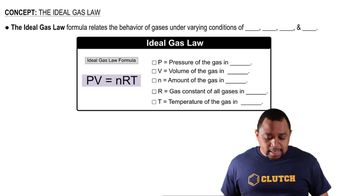
The Ideal Gas Law is a fundamental equation in chemistry that relates the pressure, volume, temperature, and number of moles of a gas. It is expressed as PV = nRT, where P is pressure, V is volume, n is the number of moles, R is the ideal gas constant, and T is temperature in Kelvin. This law assumes that gas particles do not interact and occupy no volume, making it applicable under many conditions but not all.
추천 영상:
가이드 코스
01:15
Ideal Gas Law Formula

Van der Waals Equation

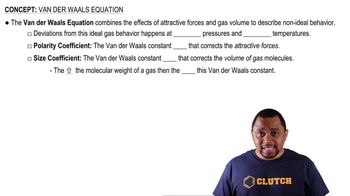
The Van der Waals equation is an adjustment of the Ideal Gas Law that accounts for the volume occupied by gas molecules and the attractive forces between them. It is expressed as (P + a(n/V)²)(V - nb) = nRT, where 'a' and 'b' are constants specific to each gas. This equation provides a more accurate description of real gas behavior, especially at high pressures and low temperatures, where deviations from ideality are significant.
추천 영상:
가이드 코스
01:40
Van der Waals Equation

Pressure Units and Conversion

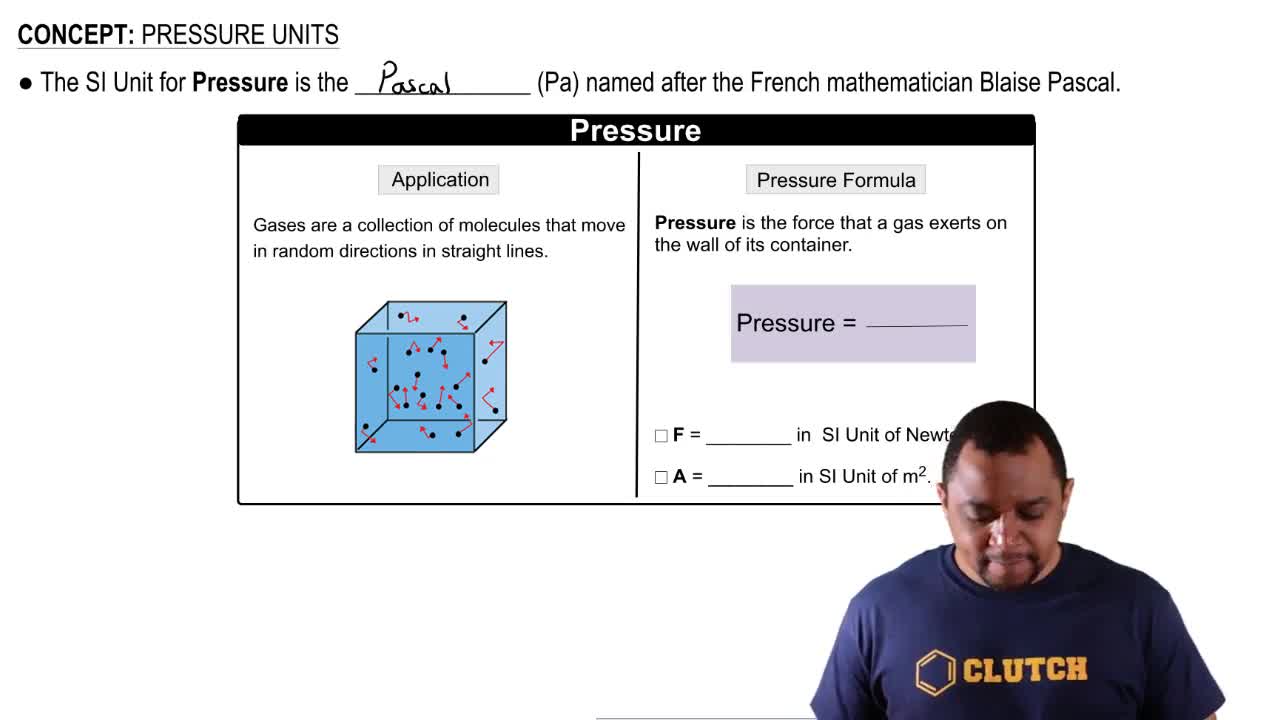
Pressure is a measure of force exerted per unit area and is commonly expressed in units such as atmospheres (atm), pascals (Pa), or mmHg. In calculations involving gases, it is crucial to ensure that pressure is in the correct units that correspond with the other variables in the gas equations. Conversions may be necessary, for example, converting mmHg to atm by using the conversion factor 1 atm = 760 mmHg.
추천 영상: