
Suppose you are given two flasks at the same temperature, one of volume 2 L and the other of volume 3 L. The 2-L flask contains 4.8 g of gas, and the gas pressure is x atm. The 3-L flask contains 0.36 g of gas, and the gas pressure is 0.1x. Do the two gases have the same molar mass? If not, which contains the gas of higher molar mass?
Ch.10 - Gases

10장, 문제 33
Complete the following table for an ideal gas:
검증된 단계별 안내1
Identify the known variables provided in the problem for each row of the table, such as pressure (P), volume (V), number of moles (n), and temperature (T).
Use the ideal gas law equation, PV = nRT, where R is the ideal gas constant. If any variable is missing, rearrange the equation to solve for the missing variable.
Convert all units to the appropriate SI units: pressure in pascals (Pa), volume in cubic meters (m^3), temperature in Kelvin (K), and the amount of substance in moles (mol).
Plug the known values into the rearranged ideal gas law equation to solve for the unknown variable. Ensure that all units are consistent to avoid errors in calculation.
Check the completed table for consistency and accuracy in the values calculated, ensuring that they adhere to the behavior expected from an ideal gas under the given conditions.

비슷한 문제에 대한 검증된 영상 답변:
이 영상 해법은 위 문제에 도움이 된다고 튜터들이 추천한 것입니다.
영상 길이:
7m도움이 되었나요?
주요 개념
질문에 올바르게 답하기 위해 반드시 이해해야 하는 핵심 개념들은 다음과 같습니다.
Ideal Gas Law
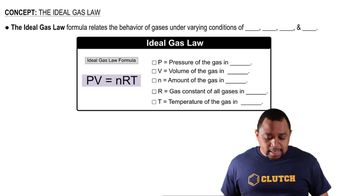
The Ideal Gas Law is a fundamental equation in chemistry that relates the pressure, volume, temperature, and number of moles of an ideal gas. It is expressed as PV = nRT, where P is pressure, V is volume, n is the number of moles, R is the ideal gas constant, and T is temperature in Kelvin. This law helps predict the behavior of gases under various conditions.
추천 영상:
가이드 코스
Ideal Gas Law Formula
Gas Properties
Gases have unique properties that distinguish them from solids and liquids, including low density, compressibility, and the ability to fill their container. The behavior of gases can be described using various laws, such as Boyle's Law (pressure-volume relationship) and Charles's Law (volume-temperature relationship), which are essential for understanding how gases respond to changes in conditions.
추천 영상:
가이드 코스
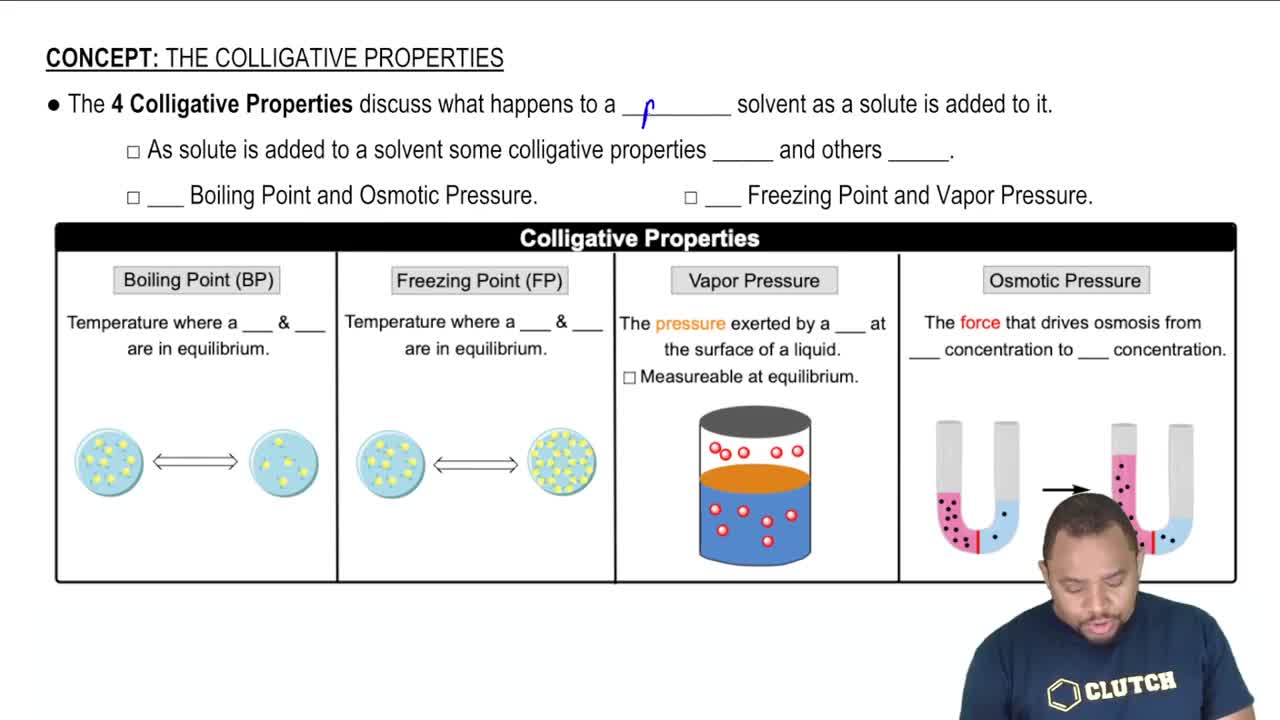
Colligative Properties
Kinetic Molecular Theory
The Kinetic Molecular Theory explains the behavior of gases at a molecular level, positing that gas particles are in constant, random motion and that their collisions with each other and the walls of their container are elastic. This theory helps to explain gas pressure as a result of particle collisions and provides insight into temperature as a measure of the average kinetic energy of the gas particles.
추천 영상:
가이드 코스
Kinetic Molecular Theory
관련 실천
교과서 질문
교과서 질문
Suppose you are given two 1-L flasks and told that one contains a gas of molar mass 30 and the other a gas of molar mass 60, both at the same temperature. The pressure in flask A is x atm, and the mass of gas in the flask is 1.2 g. The pressure in flask B is 0.5x atm, and the mass of gas in that flask is 1.2 g. Which flask contains the gas of molar mass 30, and which contains the gas of molar mass 60?
교과서 질문
(d) If you measure pressure in bars instead of atmospheres, calculate the corresponding value of R in L-bar/mol-K.
858
views
