

Ch.10 - Gases
Brown - Chemistry: The Central Science 15th Edition
Brown15th EditionChemistry: The Central ScienceISBN: 9780137542970당신이 사용하는 게 아니라요?교과서 변경
10장, 문제 19c

The typical atmospheric pressure on top of Mount Everest (29,032 ft) is about 265 torr. Convert this pressure to c. pascals,

검증된 단계별 안내
1
Start by understanding the relationship between different pressure units. We know that 1 atm = 760 torr and 1 atm = 101325 pascals.
Set up a conversion factor to convert from torr to atm. Use the relationship: \( \text{Pressure in atm} = \frac{\text{Pressure in torr}}{760} \).
Convert the given pressure from torr to atm using the conversion factor: \( \text{Pressure in atm} = \frac{265}{760} \).
Now, convert the pressure from atm to pascals using the relationship: \( \text{Pressure in pascals} = \text{Pressure in atm} \times 101325 \).
Multiply the pressure in atm by 101325 to find the pressure in pascals.

비슷한 문제에 대한 검증된 영상 답변:

이 영상 해법은 위 문제에 도움이 된다고 튜터들이 추천한 것입니다.
영상 길이:
2m

주요 개념

질문에 올바르게 답하기 위해 반드시 이해해야 하는 핵심 개념들은 다음과 같습니다.

Pressure Units

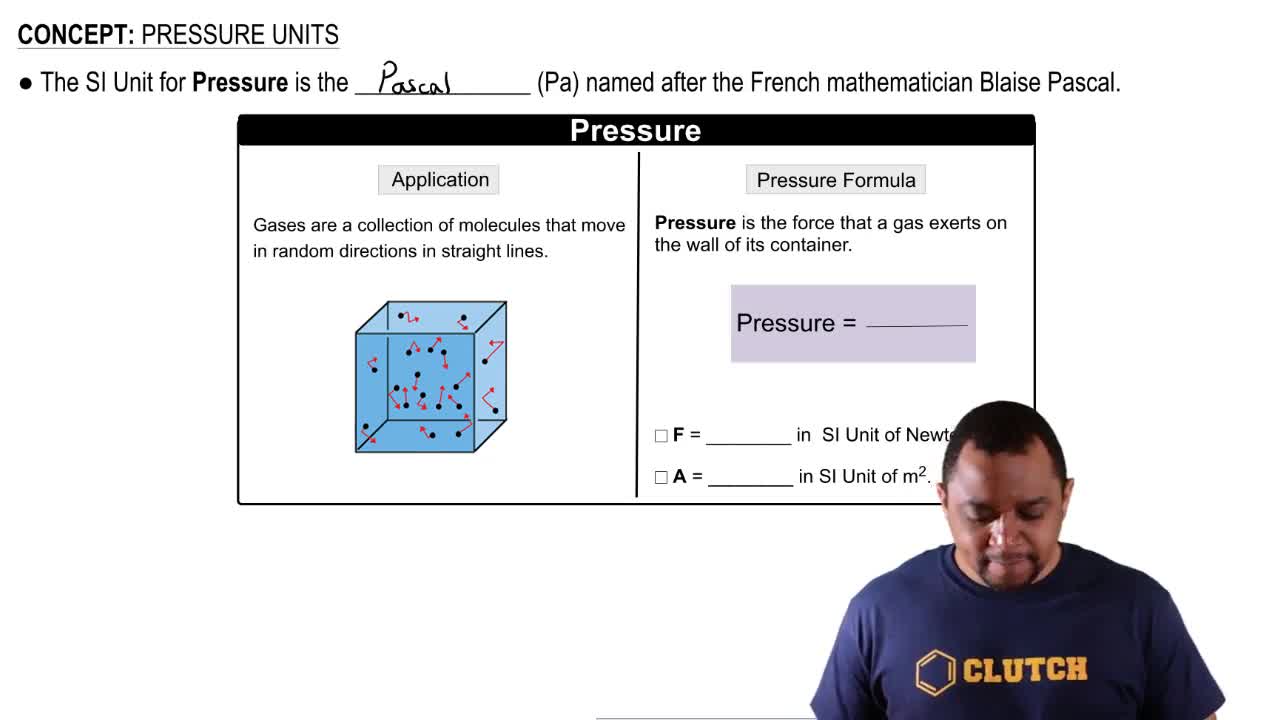
Pressure is a measure of force applied per unit area, commonly expressed in various units such as torr, pascals (Pa), and atmospheres (atm). Understanding these units is crucial for converting between them, as each unit represents a different scale of measurement. For instance, 1 torr is defined as 1/760 of an atmosphere, while 1 pascal is defined as one newton per square meter.
추천 영상:

Conversion Factors

Conversion factors are numerical values used to convert a quantity from one unit to another. In the context of pressure, knowing the relationship between torr and pascals is essential for accurate conversions. Specifically, 1 torr is equivalent to approximately 133.322 pascals, which allows for straightforward calculations when converting atmospheric pressure values.
추천 영상:
가이드 코스
01:56
Conversion Factors

Atmospheric Pressure

Atmospheric pressure is the force exerted by the weight of air above a given point, typically measured at sea level. It decreases with altitude, which is why the pressure on Mount Everest is significantly lower than at sea level. Understanding how atmospheric pressure varies with elevation is important for interpreting pressure readings in different geographical locations.
추천 영상:
가이드 코스
02:09
Total Pressure Example