
At standard temperature and pressure, the molar volumes of Cl2 and NH3 gases are 22.06 and 22.40 L, respectively. (c) The densities of crystalline Cl2 and NH3 at 160 K are 2.02 and 0.84 g/cm3, respectively. Calculate their molar volumes.
Ch.11 - Liquids and Intermolecular Forces

11장, 문제 13
As a metal such as lead melts, what happens to (a) the average kinetic energy of the atoms? (b) the average distance between the atoms?
검증된 단계별 안내1
Step 1: Understand that melting is a phase change from solid to liquid, which occurs at a constant temperature for a pure substance.
Step 2: Recognize that during melting, the temperature remains constant, so the average kinetic energy of the atoms, which is directly related to temperature, does not change.
Step 3: Consider the structure of a solid, where atoms are closely packed in a fixed arrangement, and compare it to a liquid, where atoms are more loosely arranged and can move past each other.
Step 4: Realize that as the metal melts, the rigid structure breaks down, allowing atoms to move more freely, which increases the average distance between them.
Step 5: Conclude that during melting, while the average kinetic energy of the atoms remains constant, the average distance between the atoms increases as the solid structure transitions to a liquid state.
주요 개념
질문에 올바르게 답하기 위해 반드시 이해해야 하는 핵심 개념들은 다음과 같습니다.
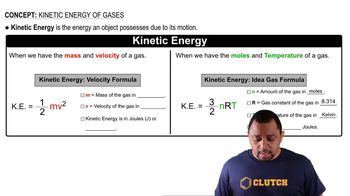
Kinetic Energy and Temperature
Kinetic energy is the energy of motion, and in the context of atoms, it relates to their temperature. As a substance heats up, the average kinetic energy of its atoms increases, leading to more vigorous motion. This is crucial for understanding phase changes, such as melting, where the temperature rises until the solid structure breaks down.
추천 영상:
가이드 코스
Kinetic Energy Formulas
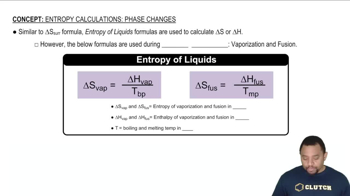
Phase Changes
Phase changes refer to the transitions between solid, liquid, and gas states of matter. During melting, a solid absorbs heat, causing its atoms to gain kinetic energy and move apart, transitioning into a liquid state. This process illustrates how energy input affects the arrangement and behavior of atoms in different phases.
추천 영상:
가이드 코스
Entropy in Phase Changes
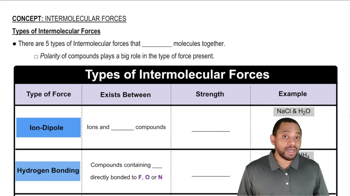
Interatomic Forces
Interatomic forces are the attractive and repulsive forces between atoms that determine the structure and stability of a material. In solids, these forces keep atoms closely packed. As a metal like lead melts, these forces weaken, allowing atoms to move further apart, which increases the average distance between them and facilitates the transition to a liquid state.
추천 영상:
가이드 코스
Types of Intermolecular Forces
관련 실천
교과서 질문
2410
views
교과서 질문
(c) What happens to a gas if you put it under extremely high pressure?
915
views
교과서 질문
(a) How does the average kinetic energy of molecules com- pare with the average energy of attraction between mole- cules in solids, liquids, and gases?
775
views
교과서 질문
At standard temperature and pressure, the molar volumes of Cl2 and NH3 gases are 22.06 and 22.40 L, respectively (b) On cooling to 160 K, both substances form crystalline solids. Do you expect the molar volumes to decrease or increase on cooling the gases to 160 K?
605
views
교과서 질문
At room temperature, Si is a solid, CCl4 is a liquid, and Ar is a gas. List these substances in order of (a) increasing intermolecular energy of attraction
1604
views
교과서 질문
List the three states of matter in order of (b) increasing intermolecular attraction.
362
views
