
Ch.11 - Liquids and Intermolecular Forces
Brown - Chemistry: The Central Science 15th Edition
Brown15th EditionChemistry: The Central ScienceISBN: 9780137542970당신이 사용하는 게 아니라요?교과서 변경
11장, 문제 73

In all four liquid crystalline phases shown in Figure 11.32, the long axis of the molecule preferentially orders along one or more specific directions. In three of the four phases the molecules also lose some freedom of translational motion. In which of the four liquid crystalline phases do the molecules retain the freedom to move in all three directions that they possess in the liquid phase: nematic, smectic A, smectic C, or cholesteric?

검증된 단계별 안내
1
Understand the characteristics of each liquid crystalline phase: Nematic, Smectic A, Smectic C, and Cholesteric.
Nematic phase: Molecules are oriented in the same direction but have no positional order, allowing them to move freely in all directions.
Smectic A and Smectic C phases: Molecules are organized into layers, restricting their movement to within the layers, thus losing some translational freedom.
Cholesteric phase: Similar to the nematic phase but with a helical twist, which can affect the freedom of movement.
Identify that the nematic phase is the one where molecules retain the freedom to move in all three directions, similar to the liquid phase.

비슷한 문제에 대한 검증된 영상 답변:

이 영상 해법은 위 문제에 도움이 된다고 튜터들이 추천한 것입니다.
영상 길이:
4m

주요 개념

질문에 올바르게 답하기 위해 반드시 이해해야 하는 핵심 개념들은 다음과 같습니다.

Liquid Crystalline Phases

Liquid crystals are materials that exhibit properties between those of conventional liquids and solid crystals. They can flow like a liquid but have some degree of molecular order, which can be categorized into different phases, such as nematic, smectic, and cholesteric. Each phase has distinct characteristics regarding molecular orientation and movement.
추천 영상:
가이드 코스
01:31
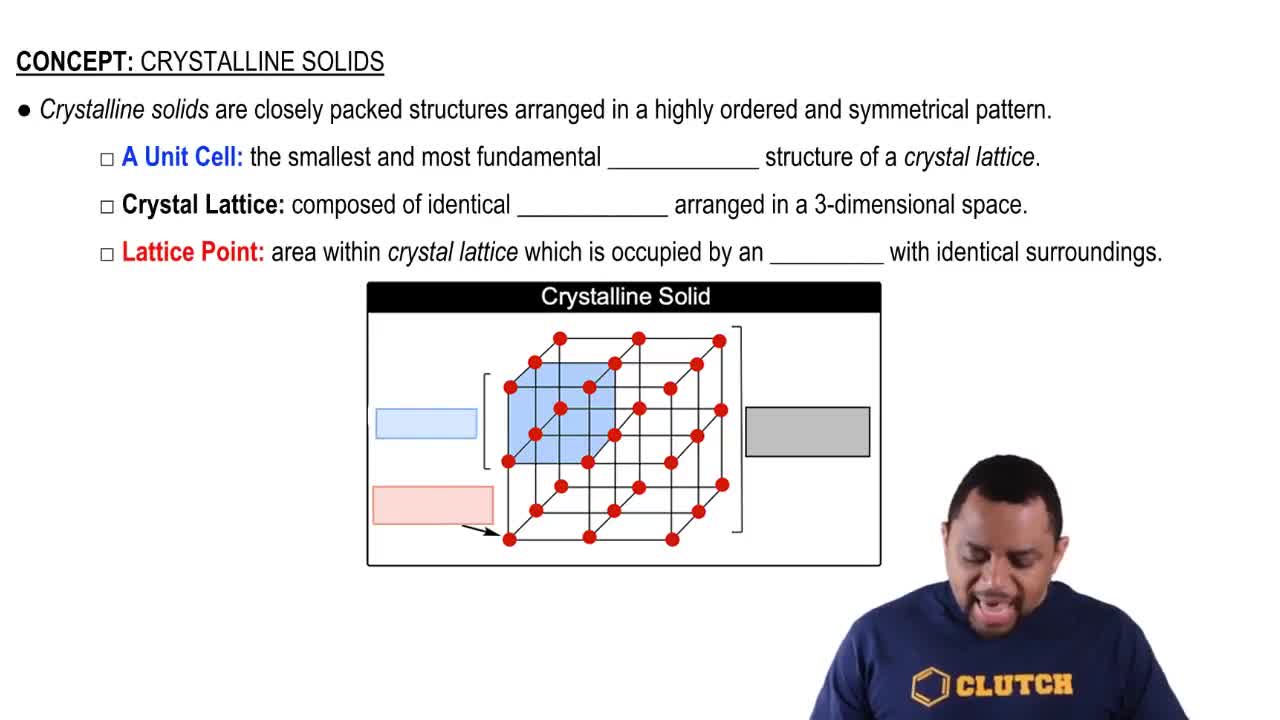
Crystalline Solids Structure

Nematic Phase

In the nematic phase, the long axes of the molecules are aligned in a preferred direction, but they retain the ability to move freely in the plane perpendicular to this direction. This means that while there is some order in molecular orientation, the molecules can still translate freely, similar to a liquid, allowing for fluidity and responsiveness to external forces.
추천 영상:
가이드 코스
03:22
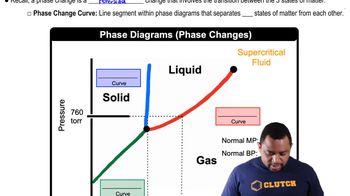
Phase Changes in Diagrams

Smectic Phase

The smectic phase is characterized by a higher degree of order compared to the nematic phase, where molecules are arranged in layers. In smectic A, the molecules are aligned within the layers but can slide past one another, while in smectic C, there is a tilt in the molecular arrangement. This layered structure restricts translational motion, unlike the nematic phase where such freedom is maintained.
추천 영상:
가이드 코스
03:22
Phase Changes in Diagrams