Ch.11 - Liquids and Intermolecular Forces
Brown - Chemistry: The Central Science 15th Edition
Brown15th EditionChemistry: The Central ScienceISBN: 9780137542970당신이 사용하는 게 아니라요?교과서 변경
11장, 문제 57d

Using the vapor-pressure curves in Figure 11.24, (d) estimate the external pressure at which diethyl ether will boil at 40 °C.

검증된 단계별 안내
1
Identify the concept: The boiling point of a liquid is the temperature at which its vapor pressure equals the external pressure.
Locate the vapor-pressure curve for diethyl ether in Figure 11.24.
Find the point on the curve where the temperature is 40 °C.
Determine the vapor pressure at this temperature by reading the corresponding value on the pressure axis.
Estimate the external pressure at which diethyl ether will boil at 40 °C by equating it to the vapor pressure found in the previous step.

비슷한 문제에 대한 검증된 영상 답변:

이 영상 해법은 위 문제에 도움이 된다고 튜터들이 추천한 것입니다.
영상 길이:
32s
도움이 되었나요?

주요 개념

질문에 올바르게 답하기 위해 반드시 이해해야 하는 핵심 개념들은 다음과 같습니다.

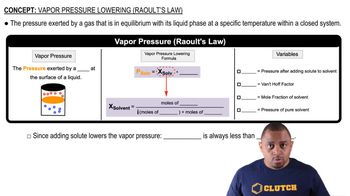
Vapor Pressure

Vapor pressure is the pressure exerted by a vapor in equilibrium with its liquid or solid phase at a given temperature. It reflects the tendency of particles to escape from the liquid phase into the vapor phase. The higher the temperature, the greater the vapor pressure, as more molecules have enough energy to overcome intermolecular forces and enter the vapor state.
추천 영상:
가이드 코스
02:40
Raoult's Law and Vapor Pressure

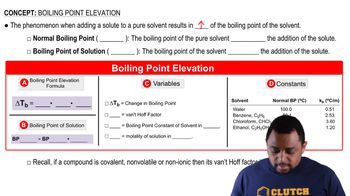
Boiling Point

The boiling point of a substance is the temperature at which its vapor pressure equals the external pressure surrounding the liquid. At this point, the liquid transitions to a gas. For a liquid to boil, the vapor pressure must be sufficient to counteract the atmospheric pressure, which is why boiling points vary with changes in external pressure.
추천 영상:
가이드 코스
03:05
Boiling Point Elevation

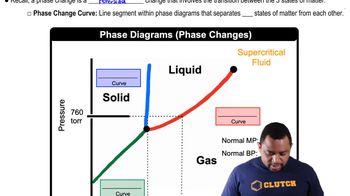
Phase Diagrams

Phase diagrams graphically represent the states of a substance under varying temperature and pressure conditions. They illustrate the boundaries between different phases (solid, liquid, gas) and can be used to determine the boiling point at specific pressures. Understanding these diagrams is crucial for estimating boiling points at non-standard pressures, such as the one required in this question.
추천 영상:
가이드 코스
03:22
Phase Changes in Diagrams
관련 실천
교과서 질문

Appendix B lists the vapor pressure of water at various external pressures. (c) A city at an altitude of 5000 ft above sea level has a barometric pressure of 633 torr. To what temperature would you have to heat water to boil it in this city?

759
views
교과서 질문

(a) Two pans of water are on different burners of a stove. One pan of water is boiling vigorously, while the other is boiling gently. What can be said about the temperature of the water in the two pans?

663
views
교과서 질문

You are high up in the mountains and boil water to make some tea. However, when you drink your tea, it is not as hot as it should be. You try again and again, but the water is just not hot enough to make a hot cup of tea. Which is the best explanation for this result? (a) High in the mountains, it is probably very dry, and so the water is rapidly evaporating from your cup and cooling it. (b) High in the mountains, it is probably very windy, and so the water is rapidly evaporating from your cup and cooling it. (c) High in the mountains, the air pressure is significantly less than 1 atm, so the boiling point of water is much lower than at sea level. (d) High in the mountains, the air pressure is significantly less than 1 atm, so the boiling point of water is much higher than at sea level.

1034
views
교과서 질문

Referring to Figure 11.29, describe the phase changes (and the temperatures at which they occur) when CO2 is heated from -80 to -20°C at (a) a constant pressure of 3 atm,

1224
views
교과서 질문

The phase diagram for neon is

Use the phase diagram to answer the following questions. (a) What is the approximate value of the normal melting point?

1268
views