Ch.12 - Solids and Modern Materials
Brown - Chemistry: The Central Science 15th Edition
Brown15th EditionChemistry: The Central ScienceISBN: 9780137542970당신이 사용하는 게 아니라요?교과서 변경
12장, 문제 51e

The molecular-orbital diagrams for two- and four-atom linear chains of lithium atoms are shown in Figure 12.21. Construct a molecular-orbital diagram for a chain containing six lithium atoms and use it to answer the following questions: e. How many nodes are in the lowest-energy unoccupied molecular orbital (LUMO)?

검증된 단계별 안내
1
insert step 1: Understand that a molecular orbital (MO) diagram for a chain of atoms shows the energy levels of the molecular orbitals formed from the atomic orbitals of the atoms in the chain.
insert step 2: Recognize that for a linear chain of lithium atoms, the molecular orbitals are formed by the combination of the 2s atomic orbitals of each lithium atom.
insert step 3: Recall that the number of molecular orbitals formed is equal to the number of atomic orbitals combined. For a chain of six lithium atoms, there will be six molecular orbitals.
insert step 4: Arrange these molecular orbitals in order of increasing energy, starting with the lowest energy (bonding) orbital and ending with the highest energy (antibonding) orbital.
insert step 5: Identify the lowest-energy unoccupied molecular orbital (LUMO) and determine the number of nodes it contains. The number of nodes in a molecular orbital is typically one less than the number of the orbital in the sequence, starting from zero for the lowest energy orbital.

비슷한 문제에 대한 검증된 영상 답변:

이 영상 해법은 위 문제에 도움이 된다고 튜터들이 추천한 것입니다.
영상 길이:
2m
도움이 되었나요?

주요 개념

질문에 올바르게 답하기 위해 반드시 이해해야 하는 핵심 개념들은 다음과 같습니다.

Molecular Orbitals

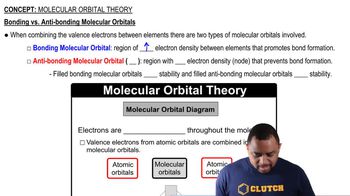
Molecular orbitals (MOs) are formed by the linear combination of atomic orbitals (LCAO) when atoms bond together. In a molecular orbital diagram, these orbitals are depicted based on their energy levels and the number of nodes they possess. The arrangement of MOs helps predict the electronic structure and properties of the molecule, including bonding and antibonding interactions.
추천 영상:
가이드 코스
03:06
Molecular Orbital Theory

Nodes in Molecular Orbitals

Nodes are regions in a molecular orbital where the probability of finding an electron is zero. The number of nodes in an orbital is related to its energy level; as the energy increases, the number of nodes also increases. For the lowest-energy unoccupied molecular orbital (LUMO), understanding the node count is crucial for predicting its reactivity and stability in chemical processes.
추천 영상:
가이드 코스
03:06
Molecular Orbital Theory

Linear Chains and Orbital Overlap

In linear chains of atoms, such as lithium, the overlap of atomic orbitals leads to the formation of molecular orbitals that can accommodate more electrons as the number of atoms increases. The pattern of bonding and antibonding orbitals changes with the number of atoms, affecting the energy levels and node structure of the MOs. This concept is essential for constructing the molecular orbital diagram for a six-atom chain and analyzing its electronic properties.
추천 영상:
가이드 코스
03:06
Molecular Orbital Theory
관련 실천