
Ch.12 - Solids and Modern Materials
Brown - Chemistry: The Central Science 15th Edition
Brown15th EditionChemistry: The Central ScienceISBN: 9780137542970당신이 사용하는 게 아니라요?교과서 변경
12장, 문제 125b

(b) When subjected to high pressure and heated, polyvinyl chloride converts to diamond. During this transformation which bonds are most likely to break first?
Table showing average bond energies for various chemical bonds in kJ/mol.

검증된 단계별 안내
1
Identify the bonds present in polyvinyl chloride (PVC). PVC primarily contains C-H, C-C, and C-Cl bonds.
Refer to the provided table to find the bond energies for C-H, C-C, and C-Cl bonds. The bond energies are: C-H (414 kJ/mol), C-C (347 kJ/mol), and C-Cl (339 kJ/mol).
Compare the bond energies to determine which bond is the weakest. The bond with the lowest bond energy will break first.
From the bond energies, identify that the C-Cl bond has the lowest bond energy (339 kJ/mol) among the bonds in PVC.
Conclude that during the transformation of PVC to diamond under high pressure and heat, the C-Cl bonds are most likely to break first.

비슷한 문제에 대한 검증된 영상 답변:

이 영상 해법은 위 문제에 도움이 된다고 튜터들이 추천한 것입니다.
영상 길이:
1m
도움이 되었나요?

주요 개념

질문에 올바르게 답하기 위해 반드시 이해해야 하는 핵심 개념들은 다음과 같습니다.

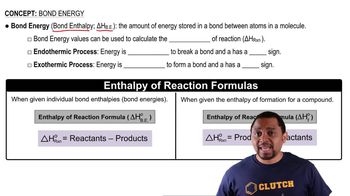
Bond Energy

Bond energy is the amount of energy required to break a bond between two atoms in a molecule. It is a measure of the strength of the bond; higher bond energies indicate stronger bonds. In the context of the transformation of polyvinyl chloride to diamond, understanding bond energies helps identify which bonds are likely to break first under high pressure and temperature.
추천 영상:

Types of Chemical Bonds

Chemical bonds can be classified into different types, including covalent, ionic, and metallic bonds. Covalent bonds, formed by the sharing of electrons, are particularly relevant here, as polyvinyl chloride primarily consists of carbon and chlorine atoms bonded covalently. The type of bond influences its energy and stability, which is crucial for predicting which bonds will break during the transformation process.
추천 영상:

Thermodynamics of Reactions

Thermodynamics involves the study of energy changes during chemical reactions. When polyvinyl chloride is subjected to high pressure and heat, the energy input can overcome the bond energies, leading to bond breaking and reformation into a different structure, such as diamond. Understanding the thermodynamic principles helps in predicting the feasibility and direction of the transformation.
추천 영상:
가이드 코스
01:18
First Law of Thermodynamics
관련 실천
교과서 질문

Although polyethylene can twist and turn in random ways, the most stable form is a linear one with the carbon backbone oriented as shown in the following figure:

The solid wedges in the figure indicate bonds from carbon that come out of the plane of the page; the dashed wedges indicate bonds that lie behind the plane of the page. (a) What is the hybridization of orbitals at each carbon atom? What angles do you expect between the bonds?

352
views
교과서 질문

One method to synthesize ionic solids is by the heating of two reactants at high temperatures. Consider the reaction of FeO with TiO2 to form FeTiO3. Determine the amount of each of the two reactants to prepare 2.500 g FeTiO3, assuming the reaction goes to completion. (b) Calculate the formula weight of FeTiO3.

487
views
교과서 질문

Employing the bond enthalpy values listed in Table 8.3 estimate the molar enthalpy change occurring upon c. formation of polyethylene terephthalate (PET).

1
views
교과서 질문

(a) In polyvinyl chloride shown in Table 12.6, which bonds have the lowest average bond enthalpy?

2242
views
교과서 질문

(c) Employing the values of average bond enthalpy in Table 8.3, estimate the overall enthalpy change for converting PVC to diamond.

교과서 질문

Silicon has the diamond structure with a unit cell edge length of 5.43 Å and eight atoms per unit cell. (b) Suppose you dope that 1 cm3 sample of silicon with 1 ppm of phosphorus that will increase the conductivity by a factor of a million. How many milligrams of phosphorus are required?

1395
views