
Both covalent-network solids and ionic solids can have melting points well in excess of room temperature, and both can be poor conductors of electricity in their pure form. However, in other ways their properties are quite different. (a) Which type of solid is more likely to dissolve in water?
Ch.12 - Solids and Modern Materials

12장, 문제 74
If you want to dope GaAs to make a p-type semiconductor with an element to replace As, which element(s) would you pick?
검증된 단계별 안내1
Identify the position of GaAs in the periodic table. Gallium (Ga) is in group 13 and arsenic (As) is in group 15.
Understand that a p-type semiconductor is created by introducing an element with fewer valence electrons than the element it replaces, creating 'holes' or positive charge carriers.
Since arsenic (As) is in group 15, it has 5 valence electrons. To create a p-type semiconductor, choose an element from group 14, which has 4 valence electrons.
Consider elements in group 14 that can replace arsenic in the GaAs lattice. These elements include carbon (C), silicon (Si), germanium (Ge), tin (Sn), and lead (Pb).
Select an appropriate group 14 element based on factors such as atomic size and compatibility with the GaAs lattice structure, with silicon (Si) and germanium (Ge) being common choices.
주요 개념
질문에 올바르게 답하기 위해 반드시 이해해야 하는 핵심 개념들은 다음과 같습니다.
Semiconductors
Semiconductors are materials that have electrical conductivity between that of conductors and insulators. They can be modified by adding impurities, a process known as doping, to enhance their electrical properties. In the case of GaAs (gallium arsenide), doping can create either n-type or p-type semiconductors, depending on the type of dopant used.
추천 영상:
가이드 코스
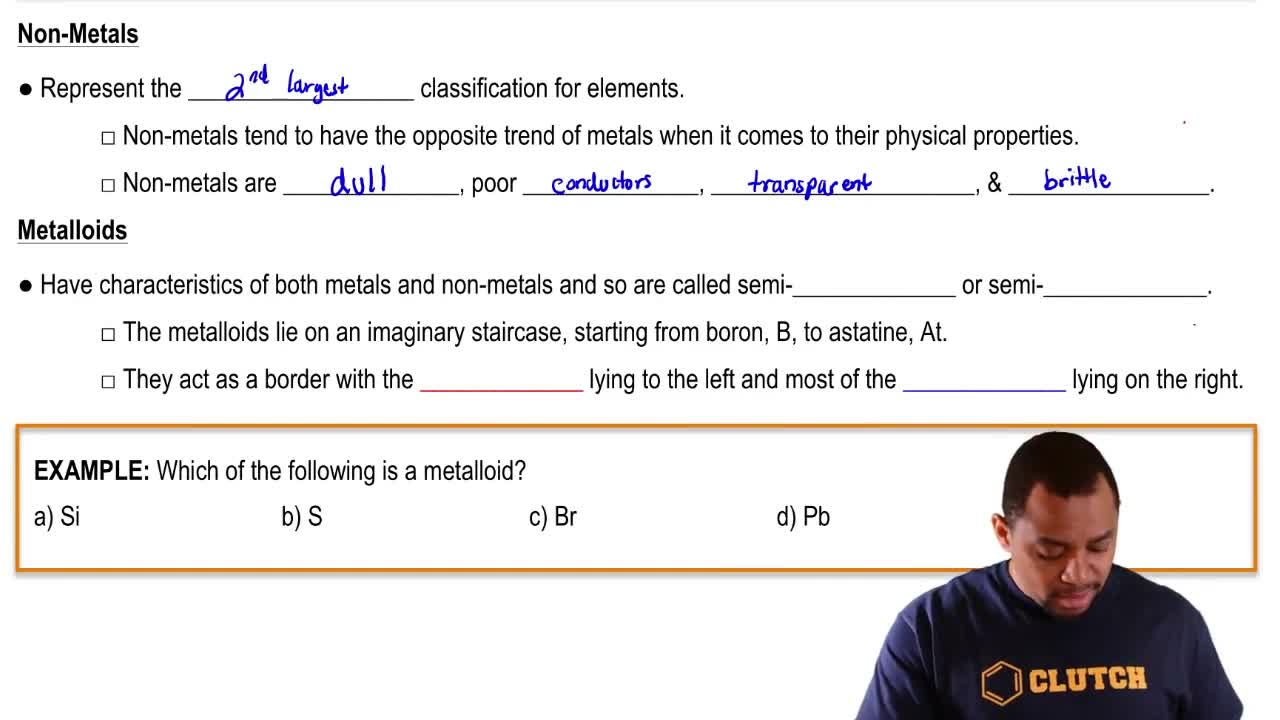
Metalloid Properties
Doping and p-type Semiconductors
Doping involves introducing specific impurities into a semiconductor to change its electrical properties. For p-type semiconductors, which have an abundance of holes (positive charge carriers), elements from group III of the periodic table, such as aluminum or indium, are typically used. These elements replace arsenic in GaAs and create holes by accepting electrons.
추천 영상:
가이드 코스
Types of Aqueous Solutions
Group III Elements
Group III elements in the periodic table, such as boron, aluminum, gallium, and indium, have three valence electrons. When these elements are used to dope a semiconductor like GaAs, they create p-type conductivity by forming covalent bonds with the surrounding atoms and leaving behind holes. This is crucial for applications in electronics and optoelectronics, where control over charge carriers is essential.
추천 영상:
가이드 코스
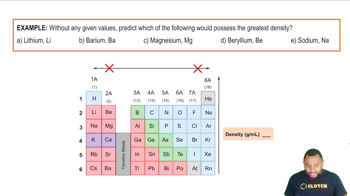
Main Group Elements: Density Example
관련 실천
교과서 질문
1156
views
교과서 질문
Cadmium telluride is an important material for solar cells. (d) With respect to silicon, does CdTe absorb a larger or smaller portion of the solar spectrum?
330
views
교과서 질문
If you want to dope GaAs to make an n-type semiconductor with an element to replace Ga, which element would you pick? a. Zn b. Al c. In or d. Si
교과서 질문
Cadmium telluride is an important material for solar cells. (b) What wavelength of light would a photon of this energy correspond to?
333
views
교과서 질문
For each of the following pairs of semiconductors, which one will have the larger band gap: (a) CdS or CdTe? (b) GaN or InP? (c) GaAs or InAs?
364
views
