Ch.12 - Solids and Modern Materials
Brown - Chemistry: The Central Science 15th Edition
Brown15th EditionChemistry: The Central ScienceISBN: 9780137542970당신이 사용하는 게 아니라요?교과서 변경
12장, 문제 84

Indicate whether the following statement is true or false: For an addition polymerization, there are no by-products of the reaction (assuming 100% yield).

검증된 단계별 안내
1
Step 1: Understand the process of addition polymerization. In addition polymerization, monomers with double bonds (like alkenes) react to form a polymer without the loss of any small molecules.
Step 2: Recognize that in addition polymerization, the polymer forms by the successive addition of monomer units, where the double bonds open up and link together.
Step 3: Note that unlike condensation polymerization, which involves the loss of small molecules like water or methanol, addition polymerization does not produce any by-products.
Step 4: Consider the assumption of 100% yield, which implies that all monomers are converted into the polymer without any side reactions or leftover monomers.
Step 5: Conclude that the statement is true because, in addition polymerization with 100% yield, there are no by-products formed.

주요 개념

질문에 올바르게 답하기 위해 반드시 이해해야 하는 핵심 개념들은 다음과 같습니다.

Addition Polymerization

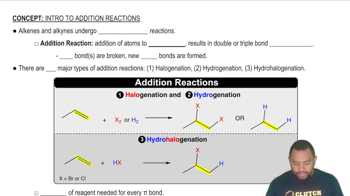
Addition polymerization is a type of polymerization where monomers with unsaturated bonds (like alkenes) react to form a polymer. This process involves the breaking of double bonds in the monomers, allowing them to link together into long chains. Unlike condensation polymerization, addition polymerization typically does not produce by-products, as the reaction solely involves the monomers combining.
추천 영상:
가이드 코스
02:55
Addition Reactions

Monomers and Polymers

Monomers are small, simple molecules that can join together to form larger structures known as polymers. In the context of addition polymerization, the monomers are usually unsaturated compounds that can undergo reactions to create long-chain molecules. Understanding the relationship between monomers and polymers is crucial for grasping how addition polymerization works and its implications for material properties.
추천 영상:
가이드 코스
04:13
Crystalline vs Amorphous Solids

Reaction Yield

Reaction yield refers to the amount of product obtained from a chemical reaction compared to the theoretical maximum amount possible. In the case of addition polymerization, if the yield is assumed to be 100%, it implies that all monomers are converted into the polymer without any loss or formation of by-products. This concept is essential for evaluating the efficiency and practicality of polymerization processes.
추천 영상:
가이드 코스
03:09
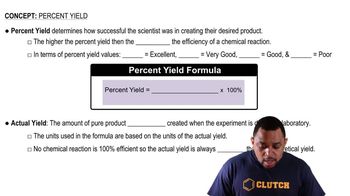
Percent Yield in Reactions