Ch.12 - Solids and Modern Materials
Brown - Chemistry: The Central Science 15th Edition
Brown15th EditionChemistry: The Central ScienceISBN: 9780137542970당신이 사용하는 게 아니라요?교과서 변경
12장, 문제 111b

Silicon carbide, SiC, has the three-dimensional structure shown in the figure.
3D structure of silicon carbide (SiC) showing atomic arrangement for bonding analysis.
(b) Would you expect the bonding in SiC to be predominantly ionic, metallic, or covalent?

검증된 단계별 안내
1
Step 1: Identify the elements present in silicon carbide (SiC). Silicon (Si) and carbon (C) are the elements involved.
Step 2: Determine the type of elements involved. Silicon is a metalloid and carbon is a non-metal.
Step 3: Analyze the electronegativity difference between silicon and carbon. Silicon has an electronegativity of 1.90 and carbon has an electronegativity of 2.55.
Step 4: Consider the bonding characteristics. A small electronegativity difference (less than 1.7) typically indicates covalent bonding.
Step 5: Examine the 3D structure of SiC. The structure shows a network of atoms bonded in a lattice, which is characteristic of covalent network solids.

비슷한 문제에 대한 검증된 영상 답변:

이 영상 해법은 위 문제에 도움이 된다고 튜터들이 추천한 것입니다.
영상 길이:
2m
도움이 되었나요?

주요 개념

질문에 올바르게 답하기 위해 반드시 이해해야 하는 핵심 개념들은 다음과 같습니다.

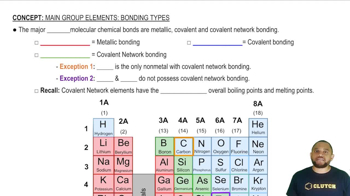
Bonding Types

There are three primary types of chemical bonding: ionic, covalent, and metallic. Ionic bonds form between atoms with significantly different electronegativities, resulting in the transfer of electrons. Covalent bonds involve the sharing of electrons between atoms with similar electronegativities, while metallic bonds occur in metals where electrons are delocalized, allowing for conductivity and malleability.
추천 영상:

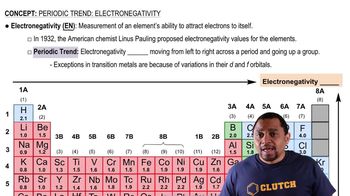
Electronegativity

Electronegativity is a measure of an atom's ability to attract and hold onto electrons. In the context of bonding, the difference in electronegativity between two atoms can help predict the type of bond that will form. A large difference typically indicates ionic bonding, while a small difference suggests covalent bonding. Silicon (Si) and carbon (C) have similar electronegativities, which influences the nature of their bonding in silicon carbide.
추천 영상:
가이드 코스
02:10
Electronegativity Trends

Crystal Structure

The crystal structure of a material describes the orderly arrangement of atoms within it. In silicon carbide (SiC), the three-dimensional structure shown in the image indicates a covalent network, where each silicon atom is covalently bonded to carbon atoms in a tetrahedral arrangement. This structure contributes to the material's hardness and thermal stability, characteristics typical of covalent compounds.
추천 영상:
가이드 코스
01:42
Resonance Structures