Describe how you would prepare each of the following aqueous solutions from water and solid KBr: b. 125 g of 0.180 m KBr.
Ch.13 - Properties of Solutions

13장, 문제 51c
Calculate the number of moles of solute present in each of the following aqueous solutions: (c) 124.0 g of a solution that is 6.45% glucose (C6H12O6) by mass.
검증된 단계별 안내1
Identify the mass percentage of glucose in the solution, which is given as 6.45%.
Calculate the mass of glucose in the solution by multiplying the total mass of the solution (124.0 g) by the mass percentage (6.45%) expressed as a decimal.
Determine the molar mass of glucose (C_6H_12O_6) by adding the atomic masses of all the atoms in the molecular formula: 6 carbon atoms, 12 hydrogen atoms, and 6 oxygen atoms.
Use the mass of glucose obtained in step 2 and the molar mass from step 3 to calculate the number of moles of glucose using the formula: \( \text{moles} = \frac{\text{mass of glucose}}{\text{molar mass of glucose}} \).
The result from step 4 will give you the number of moles of glucose present in the solution.

비슷한 문제에 대한 검증된 영상 답변:
이 영상 해법은 위 문제에 도움이 된다고 튜터들이 추천한 것입니다.
영상 길이:
3m주요 개념
질문에 올바르게 답하기 위해 반드시 이해해야 하는 핵심 개념들은 다음과 같습니다.
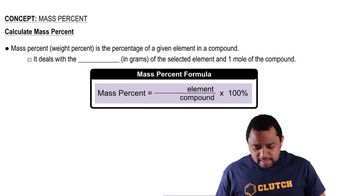
Percent by Mass
Percent by mass is a way to express the concentration of a solution, indicating the mass of solute present in a given mass of solution. In this case, a 6.45% glucose solution means that there are 6.45 grams of glucose for every 100 grams of solution. This concept is essential for determining the mass of solute in a specific mass of solution.
추천 영상:
가이드 코스
Mass Percent Calculation
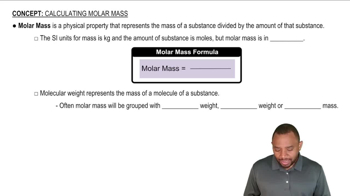
Molar Mass
Molar mass is the mass of one mole of a substance, typically expressed in grams per mole (g/mol). For glucose (C6H12O6), the molar mass is approximately 180.18 g/mol. Knowing the molar mass allows us to convert between grams of solute and moles, which is crucial for calculating the number of moles in a solution.
추천 영상:
가이드 코스
Molar Mass Concept
Moles of Solute
The number of moles of solute can be calculated using the formula: moles = mass (g) / molar mass (g/mol). This relationship is fundamental in stoichiometry and solution chemistry, as it allows us to quantify the amount of solute present in a solution, which is necessary for various calculations in chemistry.
추천 영상:
가이드 코스
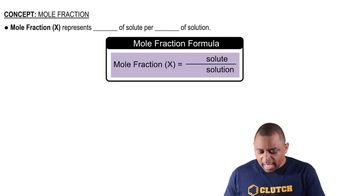
Mole Fraction Formula
관련 실천
교과서 질문
1
views
교과서 질문
Calculate the number of moles of solute present in each of the following aqueous solutions: (b) 86.4 g of 0.180 m KCl,
953
views
교과서 질문
Calculate the number of moles of solute present in each of the following solutions: (a) 255 mL of 1.50 M HNO3(aq),
1422
views
교과서 질문
The density of toluene (C7H8) is 0.867 g/mL, and the density of thiophene (C4H4S) is 1.065 g/mL. A solution is made by dissolving 8.10 g of thiophene in 250.0 mL of toluene. (a) Calculate the mole fraction of thiophene in the solution.
593
views
교과서 질문
The density of toluene (C7H8) is 0.867 g/mL, and the density of thiophene (C4H4S) is 1.065 g/mL. A solution is made by dissolving 8.10 g of thiophene in 250.0 mL of toluene. (b) Calculate the molality of thiophene in the solution.
1763
views