Ch.13 - Properties of Solutions
Brown - Chemistry: The Central Science 15th Edition
Brown15th EditionChemistry: The Central ScienceISBN: 9780137542970당신이 사용하는 게 아니라요?교과서 변경
13장, 문제 95b

Most fish need at least 4 ppm dissolved O2 in water for survival. (b) What partial pressure of O2 above water is needed to obtain 4 ppm O2 in water at 10 °C? (The Henry's law constant for O2 at this temperature is 1.71⨉10-3 mol/L-atm.)

검증된 단계별 안내
1
Understand that ppm (parts per million) is a way to express concentration. For gases dissolved in water, 4 ppm means 4 mg of O_2 per liter of water.
Convert the concentration from ppm to molarity (mol/L). Use the molar mass of O_2, which is approximately 32.00 g/mol, to convert mg/L to mol/L.
Apply Henry's Law, which states that the concentration of a gas in a liquid is directly proportional to the partial pressure of the gas above the liquid. The formula is C = kP, where C is the concentration of the gas, k is the Henry's law constant, and P is the partial pressure.
Rearrange the formula to solve for the partial pressure: P = C/k.
Substitute the values for C (from step 2) and k (given as 1.71⨉10^-3 mol/L-atm) into the equation to find the partial pressure of O_2 needed.

비슷한 문제에 대한 검증된 영상 답변:

이 영상 해법은 위 문제에 도움이 된다고 튜터들이 추천한 것입니다.
영상 길이:
3m
도움이 되었나요?

주요 개념

질문에 올바르게 답하기 위해 반드시 이해해야 하는 핵심 개념들은 다음과 같습니다.

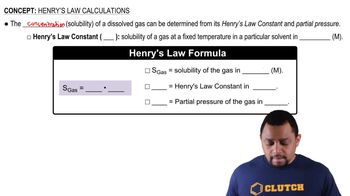
Henry's Law

Henry's Law states that the amount of a gas that dissolves in a liquid at a given temperature is directly proportional to the partial pressure of that gas above the liquid. This relationship can be expressed mathematically as C = kH * P, where C is the concentration of the gas in the liquid, kH is the Henry's law constant, and P is the partial pressure of the gas.
추천 영상:
가이드 코스
01:40
Henry's Law Calculations

Dissolved Oxygen Concentration

Dissolved oxygen concentration refers to the amount of oxygen that is present in water, typically measured in parts per million (ppm) or milligrams per liter (mg/L). For aquatic life, maintaining a certain level of dissolved oxygen is crucial for survival, as it is essential for respiration in fish and other organisms.
추천 영상:
가이드 코스
07:35
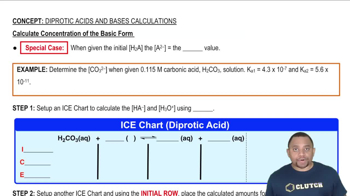
Calculate Concentration of the Basic Form

Temperature Effects on Gas Solubility

The solubility of gases in liquids is influenced by temperature; generally, as temperature increases, the solubility of gases decreases. This is important in aquatic environments, as warmer water holds less dissolved oxygen, which can affect fish survival and ecosystem health.
추천 영상:
가이드 코스
01:44
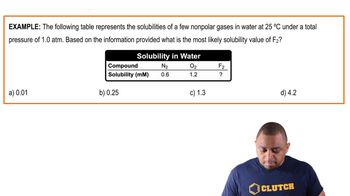
Gas Solubility Example
관련 실천
교과서 질문

Most fish need at least 4 ppm dissolved O2 in water for survival. (a) What is this concentration in mol/L?

908
views

교과서 질문

The presence of the radioactive gas radon (Rn) in well water presents a possible health hazard in parts of the United States. (a) Assuming that the solubility of radon in water with 1 atm pressure of the gas over the water at 30 °C is 7.27⨉10-3 M, what is the Henry's law constant for radon in water at this temperature?

579
views
1
rank
교과서 질문

The presence of the radioactive gas radon (Rn) in well water presents a possible health hazard in parts of the United States. (b) A sample consisting of various gases contains 3.5 × 10⁻⁶ mole fraction of radon. This gas at a total pressure of 32 atm is shaken with water at 30 °C. Calculate the molar concentration of radon in the water.

교과서 질문

The 'free-base' form of cocaine (C17H21NO4) and its protonated hydrochloride form (C17H21NO4) are shown below; the free-base form can be converted to the hydrochloride form with one equivalent of HCl. For clarity, not all the carbon and hydrogen atoms are shown; each vertex represents a carbon atom with the appropriate number of hydrogen atoms so that each carbon makes four bonds to other atoms (e) How many mL of a concentrated 18.0 M HCl aqueous solution would it take to convert 1.00 kilograms (a 'kilo') of the free-base form of cocaine into its hydrochloride form?

1668
views
교과서 질문

A supersaturated solution of sucrose (C12H22O11) is made by dissolving sucrose in hot water and slowly letting the solution cool to room temperature. After a long time, the excess sucrose crystallizes out of the solution. Indicate whether each of the following statements is true or false: (b) After the excess sucrose has crystallized out, the system is now unstable and is not in equilibrium.

1355
views