
Lauryl alcohol is obtained from coconut oil and is used to make detergents. A solution of 5.00 g of lauryl alcohol in 0.100 kg of benzene freezes at 4.1 °C. What is the molar mass of lauryl alcohol from these data? See Table 13.3 for the normal freezing point and 𝐾f of benzene.
Ch.13 - Properties of Solutions

13장, 문제 80
Seawater contains 34 g of salts for every liter of solution. Assuming that the solute consists entirely of NaCl (in fact, over 90% of the salt is indeed NaCl), calculate the osmotic pressure of seawater at 20 °C
검증된 단계별 안내1
Identify the formula for osmotic pressure: \( \Pi = iMRT \), where \( \Pi \) is the osmotic pressure, \( i \) is the van't Hoff factor, \( M \) is the molarity, \( R \) is the ideal gas constant, and \( T \) is the temperature in Kelvin.
Determine the van't Hoff factor \( i \) for NaCl. Since NaCl dissociates into two ions (Na^+ and Cl^-), \( i = 2 \).
Convert the temperature from Celsius to Kelvin: \( T = 20 + 273.15 = 293.15 \text{ K} \).
Calculate the molarity \( M \) of the NaCl solution. First, find the molar mass of NaCl (Na: 22.99 g/mol, Cl: 35.45 g/mol), then use the given mass of NaCl (34 g/L) to find \( M = \frac{\text{mass of solute}}{\text{molar mass} \times \text{volume of solution in liters}} \).
Substitute the values into the osmotic pressure formula: \( \Pi = iMRT \), using \( R = 0.0821 \text{ L atm K}^{-1} \text{ mol}^{-1} \), and solve for \( \Pi \).

비슷한 문제에 대한 검증된 영상 답변:
이 영상 해법은 위 문제에 도움이 된다고 튜터들이 추천한 것입니다.
영상 길이:
3m주요 개념
질문에 올바르게 답하기 위해 반드시 이해해야 하는 핵심 개념들은 다음과 같습니다.
Osmotic Pressure
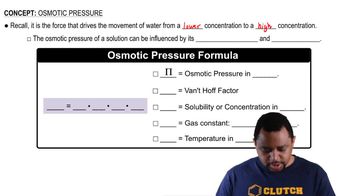
Osmotic pressure is the pressure required to prevent the flow of solvent into a solution through a semipermeable membrane. It is directly proportional to the concentration of solute particles in the solution, as described by the formula π = iCRT, where π is the osmotic pressure, i is the van 't Hoff factor, C is the molar concentration of the solute, R is the ideal gas constant, and T is the temperature in Kelvin.
추천 영상:
가이드 코스
Osmotic Pressure Formula
Van 't Hoff Factor (i)
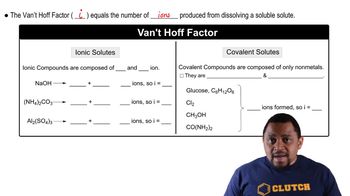
The van 't Hoff factor (i) indicates the number of particles into which a solute dissociates in solution. For NaCl, which dissociates into two ions (Na⁺ and Cl⁻), the van 't Hoff factor is 2. This factor is crucial for calculating osmotic pressure, as it affects the total concentration of solute particles in the solution.
추천 영상:
가이드 코스
Van't Hoff Factor
Molarity and Concentration
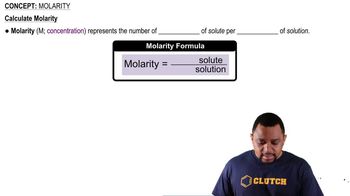
Molarity is a measure of concentration defined as the number of moles of solute per liter of solution. To calculate osmotic pressure, it is essential to convert the mass of solute (in this case, NaCl) into moles using its molar mass, and then determine the molarity of the solution. This concentration is a key component in the osmotic pressure equation.
추천 영상:
가이드 코스
Molarity Concept
관련 실천
교과서 질문
교과서 질문
Lysozyme is an enzyme that breaks bacterial cell walls. A solution containing 0.150 g of this enzyme in 210 mL of solution has an osmotic pressure of 0.953 torr at 25 °C. What is the molar mass of lysozyme?
2030
views
교과서 질문
Adrenaline is the hormone that triggers the release of extra glucose molecules in times of stress or emergency. A solution of 0.64 g of adrenaline in 36.0 g of CCl4 elevates the boiling point by 0.49 °C. Calculate the approximate molar mass of adrenaline from this data.
845
views
교과서 질문
What is the freezing point of an aqueous solution that boils at 105.0 °C?
2072
views
2
rank
