
Consider the following hypothetical aqueous reaction: A(aq) → B(aq). A flask is charged with 0.065 mol of A in a total volume of 100.0 mL. The following data are collected: Time (min) 0 10 20 30 40 Moles of A 0.065 0.051 0.042 0.036 0.031 (b) Calculate the average rate of disappearance of A for each 10-min interval in units of M>s.
Ch.14 - Chemical Kinetics

14장, 문제 18b
b. As the temperature increases, does the reaction rate usually increase or decrease?
검증된 단계별 안내1
Consider the general principle of reaction rates and temperature: According to the Arrhenius equation, reaction rate constants increase with temperature.
Understand that increasing temperature provides more kinetic energy to the reactant molecules.
Recognize that with more kinetic energy, molecules move faster and collide more frequently and with greater energy.
Recall that more frequent and energetic collisions increase the likelihood of overcoming the activation energy barrier, leading to an increased reaction rate.
Conclude that, generally, as temperature increases, the reaction rate increases.

비슷한 문제에 대한 검증된 영상 답변:
이 영상 해법은 위 문제에 도움이 된다고 튜터들이 추천한 것입니다.
영상 길이:
3m도움이 되었나요?
주요 개념
질문에 올바르게 답하기 위해 반드시 이해해야 하는 핵심 개념들은 다음과 같습니다.
Reaction Rate
The reaction rate refers to the speed at which reactants are converted into products in a chemical reaction. It is influenced by various factors, including concentration, temperature, and the presence of catalysts. Understanding how these factors affect the rate is crucial for predicting the behavior of chemical reactions.
추천 영상:
가이드 코스
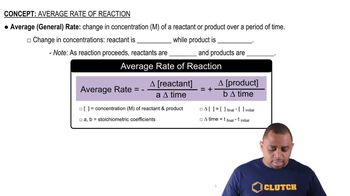
Average Rate of Reaction
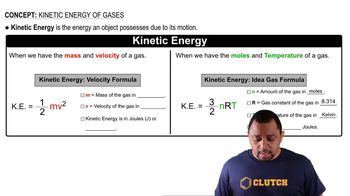
Temperature and Kinetic Energy
Temperature is a measure of the average kinetic energy of particles in a substance. As temperature increases, the kinetic energy of the molecules also increases, leading to more frequent and energetic collisions between reactant molecules. This generally results in an increased reaction rate, as more collisions can overcome the activation energy barrier.
추천 영상:
가이드 코스
Kinetic Energy Formulas
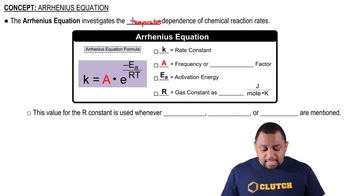
Arrhenius Equation
The Arrhenius equation quantitatively describes how temperature affects reaction rates. It states that the rate constant of a reaction increases exponentially with an increase in temperature, due to the increased kinetic energy of the molecules. This relationship highlights the importance of temperature in determining how quickly a reaction proceeds.
추천 영상:
가이드 코스
Arrhenius Equation
관련 실천
교과서 질문
1558
views
1
rank
교과서 질문
(b) Name three factors that can affect the rate of a chemical reaction.
587
views
교과서 질문
Consider the following hypothetical aqueous reaction: A(aq) → B(aq). A flask is charged with 0.065 mol of A in a total volume of 100.0 mL. The following data are collected: Time (min) 0 10 20 30 40 Moles of A 0.065 0.051 0.042 0.036 0.031 (a) Calculate the number of moles of B at each time in the table, assuming that there are no molecules of B at time zero and that A cleanly converts to B with no intermediates.
904
views
교과서 질문
(c) As a reaction proceeds, does the instantaneous reaction rate increase or decrease?
778
views
교과서 질문
(a) What are the units usually used to express the rates of reactions occurring in solution?
1033
views
