Ch.14 - Chemical Kinetics
Brown - Chemistry: The Central Science 15th Edition
Brown15th EditionChemistry: The Central ScienceISBN: 9780137542970당신이 사용하는 게 아니라요?교과서 변경
14장, 문제 46

From the following data for the first-order gas-phase isomerization of CH3NC to CH3CN at 215°C, calculate the first-order rate constant and half-life for the reaction:
Time (s) Pressure CH3NC (torr)
0 502
2000 335
5000 180
8000 95.5
12,000 41.7
15,000 22.4

검증된 단계별 안내
1
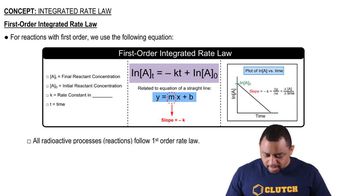
Identify that the reaction is a first-order reaction, which means the rate law is given by \( \ln [A]_t = -kt + \ln [A]_0 \), where \([A]_t\) is the concentration (or pressure) at time \(t\), \([A]_0\) is the initial concentration (or pressure), and \(k\) is the rate constant.
Use the data provided to calculate the rate constant \(k\). Choose two data points, for example, at \(t = 0\) and \(t = 2000\) seconds. Substitute these values into the first-order rate equation: \( \ln(335) = -k(2000) + \ln(502) \).
Rearrange the equation to solve for \(k\): \( k = \frac{\ln(502) - \ln(335)}{2000} \).
Calculate the half-life of the reaction using the formula for the half-life of a first-order reaction: \( t_{1/2} = \frac{0.693}{k} \).
Verify the consistency of the calculated rate constant \(k\) by using another set of data points, such as \(t = 5000\) and \(t = 8000\), and check if the calculated \(k\) is approximately the same.

비슷한 문제에 대한 검증된 영상 답변:

이 영상 해법은 위 문제에 도움이 된다고 튜터들이 추천한 것입니다.
영상 길이:
4m

주요 개념

질문에 올바르게 답하기 위해 반드시 이해해야 하는 핵심 개념들은 다음과 같습니다.

First-Order Reactions

First-order reactions are chemical reactions where the rate is directly proportional to the concentration of one reactant. This means that as the concentration of the reactant decreases, the rate of the reaction also decreases. The rate law for a first-order reaction can be expressed as rate = k[A], where k is the rate constant and [A] is the concentration of the reactant.
추천 영상:
가이드 코스
02:29
First-Order Reactions

Rate Constant (k)

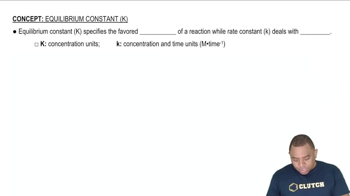
The rate constant (k) is a proportionality factor in the rate equation that is specific to a given reaction at a particular temperature. For first-order reactions, the rate constant can be determined using the integrated rate law, which relates the concentration of the reactant to time. The units of k for a first-order reaction are typically s⁻¹.
추천 영상:
가이드 코스
01:14
Equilibrium Constant K

Half-Life (t1/2)

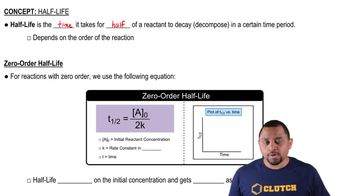
The half-life of a reaction is the time required for the concentration of a reactant to decrease to half of its initial value. For first-order reactions, the half-life is constant and does not depend on the initial concentration, calculated using the formula t1/2 = 0.693/k. This property is useful for predicting how long it will take for a reaction to reach a certain extent of completion.
추천 영상:
가이드 코스
02:17
Zero-Order Half-life