
Ch.14 - Chemical Kinetics
14์žฅ, ๋ฌธ์ œ 7b

Given the following diagrams at ๐‘ก=0 min and ๐‘ก=30 min, b. After four half-life periods for a first-order reaction, what fraction of reactant remains? [Section 14.3]

๊ฒ€์ฆ๋œ ๋‹จ๊ณ„๋ณ„ ์•ˆ๋‚ด
1
Identify that the problem involves a first-order reaction and the concept of half-life.
Recall that for a first-order reaction, the half-life (t_{1/2}) is constant and does not depend on the initial concentration.
Understand that after each half-life period, the concentration of the reactant is reduced by half.
Calculate the fraction of reactant remaining after four half-life periods using the formula: (1/2)^n, where n is the number of half-lives.
Substitute n = 4 into the formula to determine the fraction of reactant remaining after four half-life periods.

๋น„์Šทํ•œ ๋ฌธ์ œ์— ๋Œ€ํ•œ ๊ฒ€์ฆ๋œ ์˜์ƒ ๋‹ต๋ณ€:

์ด ์˜์ƒ ํ•ด๋ฒ•์€ ์œ„ ๋ฌธ์ œ์— ๋„์›€์ด ๋œ๋‹ค๊ณ  ํŠœํ„ฐ๋“ค์ด ์ถ”์ฒœํ•œ ๊ฒƒ์ž…๋‹ˆ๋‹ค.
์˜์ƒ ๊ธธ์ด:
58s

์ฃผ์š” ๊ฐœ๋…

์งˆ๋ฌธ์— ์˜ฌ๋ฐ”๋ฅด๊ฒŒ ๋‹ตํ•˜๊ธฐ ์œ„ํ•ด ๋ฐ˜๋“œ์‹œ ์ดํ•ดํ•ด์•ผ ํ•˜๋Š” ํ•ต์‹ฌ ๊ฐœ๋…๋“ค์€ ๋‹ค์Œ๊ณผ ๊ฐ™์Šต๋‹ˆ๋‹ค.

First-Order Reactions

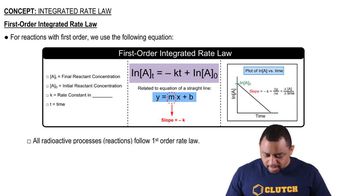
First-order reactions are chemical reactions where the rate is directly proportional to the concentration of one reactant. This means that as the concentration of the reactant decreases, the rate of the reaction also decreases. The mathematical representation of a first-order reaction is given by the equation: rate = k[A], where k is the rate constant and [A] is the concentration of the reactant.
์ถ”์ฒœ ์˜์ƒ:

Half-Life

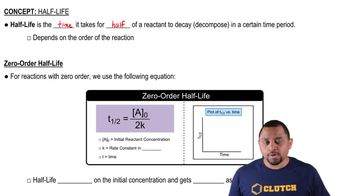
The half-life of a reaction is the time required for the concentration of a reactant to decrease to half of its initial value. For first-order reactions, the half-life is constant and does not depend on the initial concentration. This property allows for straightforward calculations of remaining reactant after multiple half-lives, as each half-life reduces the amount by half.
์ถ”์ฒœ ์˜์ƒ:

Fraction of Reactant Remaining

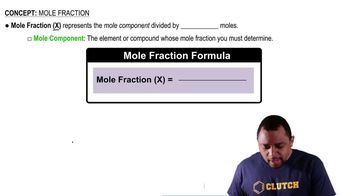
To determine the fraction of reactant remaining after a certain number of half-lives, one can use the formula: (1/2)^n, where n is the number of half-lives that have passed. After four half-lives, the fraction of the original reactant remaining would be (1/2)^4, which equals 1/16. This concept is crucial for understanding how reactants diminish over time in first-order kinetics.
์ถ”์ฒœ ์˜์ƒ: