Ch.15 - Chemical Equilibrium
15์žฅ, ๋ฌธ์ œ 58

At 373 K, ๐พ๐‘ = 0.416 for the equilibrium 2 NOBr(๐‘”) โ‡Œ 2 NO(๐‘”) + Br2(๐‘”) If the equilibrium partial pressures of NOBr(๐‘”) and Br2(๐‘”) are both 0.100 atm at 373 K, what is the equilibrium partial pressure of NO(๐‘”)?

๊ฒ€์ฆ๋œ ๋‹จ๊ณ„๋ณ„ ์•ˆ๋‚ด
1
Identify the equilibrium expression for the reaction: \( K_p = \frac{(P_{NO})^2 (P_{Br_2})}{(P_{NOBr})^2} \).
Substitute the known values into the equilibrium expression: \( K_p = 0.416 \), \( P_{NOBr} = 0.100 \) atm, and \( P_{Br_2} = 0.100 \) atm.
Rearrange the equation to solve for \( (P_{NO})^2 \): \( (P_{NO})^2 = K_p \times (P_{NOBr})^2 / P_{Br_2} \).
Substitute the known values into the rearranged equation: \( (P_{NO})^2 = 0.416 \times (0.100)^2 / 0.100 \).
Calculate \( P_{NO} \) by taking the square root of \( (P_{NO})^2 \).

๋น„์Šทํ•œ ๋ฌธ์ œ์— ๋Œ€ํ•œ ๊ฒ€์ฆ๋œ ์˜์ƒ ๋‹ต๋ณ€:

์ด ์˜์ƒ ํ•ด๋ฒ•์€ ์œ„ ๋ฌธ์ œ์— ๋„์›€์ด ๋œ๋‹ค๊ณ  ํŠœํ„ฐ๋“ค์ด ์ถ”์ฒœํ•œ ๊ฒƒ์ž…๋‹ˆ๋‹ค.
์˜์ƒ ๊ธธ์ด:
2m

์ฃผ์š” ๊ฐœ๋…

์งˆ๋ฌธ์— ์˜ฌ๋ฐ”๋ฅด๊ฒŒ ๋‹ตํ•˜๊ธฐ ์œ„ํ•ด ๋ฐ˜๋“œ์‹œ ์ดํ•ดํ•ด์•ผ ํ•˜๋Š” ํ•ต์‹ฌ ๊ฐœ๋…๋“ค์€ ๋‹ค์Œ๊ณผ ๊ฐ™์Šต๋‹ˆ๋‹ค.

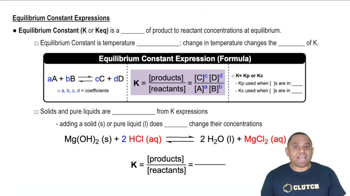
Equilibrium Constant (Kp)

The equilibrium constant, Kp, is a ratio that expresses the relationship between the partial pressures of the products and reactants at equilibrium for a given reaction at a specific temperature. For the reaction 2 NOBr(g) โ‡Œ 2 NO(g) + Br2(g), Kp is calculated using the formula Kp = (P_NO^2 * P_Br2) / (P_NOBr^2), where P represents the partial pressures of the gases involved.
์ถ”์ฒœ ์˜์ƒ:
๊ฐ€์ด๋“œ ์ฝ”์Šค
03:20
Equilibrium Constant Expressions

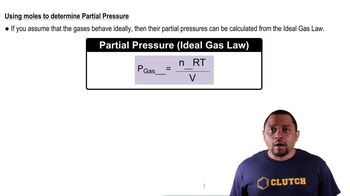
Partial Pressure

Partial pressure is the pressure exerted by a single component of a gas mixture. In the context of the equilibrium reaction, the partial pressures of NOBr, NO, and Br2 are crucial for calculating the equilibrium constant and determining the concentrations of each species at equilibrium. The total pressure of the gas mixture is the sum of the partial pressures of all components.
์ถ”์ฒœ ์˜์ƒ:

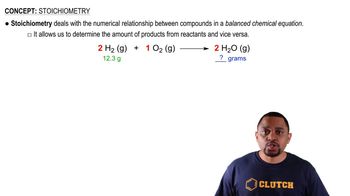
Stoichiometry of the Reaction

Stoichiometry refers to the quantitative relationship between the reactants and products in a chemical reaction. In this equilibrium, the stoichiometric coefficients indicate that for every 2 moles of NOBr that dissociate, 2 moles of NO and 1 mole of Br2 are produced. This relationship is essential for calculating the equilibrium partial pressure of NO based on the known partial pressures of NOBr and Br2.
์ถ”์ฒœ ์˜์ƒ: