Ch.15 - Chemical Equilibrium
Brown - Chemistry: The Central Science 15th Edition
Brown15th EditionChemistry: The Central ScienceISBN: 9780137542970당신이 사용하는 게 아니라요?교과서 변경
15장, 문제 69c

(c) If the temperature is raised by 100 K, does the forward rate constant kf increase by a larger or smaller amount than the reverse rate constant kr?

검증된 단계별 안내
1
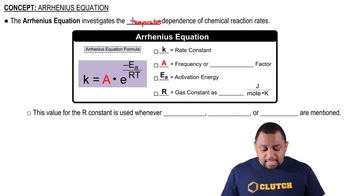
Identify the relationship between temperature and rate constants using the Arrhenius equation: \( k = A e^{-\frac{E_a}{RT}} \), where \( k \) is the rate constant, \( A \) is the pre-exponential factor, \( E_a \) is the activation energy, \( R \) is the gas constant, and \( T \) is the temperature in Kelvin.
Understand that the rate constant \( k \) increases with an increase in temperature because the exponential term \( e^{-\frac{E_a}{RT}} \) becomes larger as \( T \) increases.
Recognize that the magnitude of the increase in \( k \) depends on the activation energy \( E_a \). A higher \( E_a \) means a more significant change in \( k \) with temperature.
Compare the activation energies for the forward and reverse reactions. If \( E_{a,\text{forward}} > E_{a,\text{reverse}} \), the forward rate constant \( k_f \) will increase by a larger amount than the reverse rate constant \( k_r \) when temperature is raised.
Conclude that the change in rate constants with temperature is more pronounced for reactions with higher activation energies, and thus, the forward rate constant \( k_f \) will increase by a larger amount than the reverse rate constant \( k_r \) if its activation energy is higher.

비슷한 문제에 대한 검증된 영상 답변:

이 영상 해법은 위 문제에 도움이 된다고 튜터들이 추천한 것입니다.
영상 길이:
3m
도움이 되었나요?

주요 개념

질문에 올바르게 답하기 위해 반드시 이해해야 하는 핵심 개념들은 다음과 같습니다.

Arrhenius Equation

The Arrhenius equation describes how the rate constant of a reaction depends on temperature. It states that the rate constant (k) increases exponentially with an increase in temperature, due to the increased kinetic energy of molecules, which enhances the frequency of effective collisions. The equation is given by k = A * e^(-Ea/RT), where A is the pre-exponential factor, Ea is the activation energy, R is the gas constant, and T is the temperature in Kelvin.
추천 영상:
가이드 코스
01:20
Arrhenius Equation

Activation Energy

Activation energy (Ea) is the minimum energy required for a chemical reaction to occur. It represents the energy barrier that reactants must overcome to form products. Different reactions have different activation energies, which influence how sensitive the rate constants (k_f and k_r) are to changes in temperature. A lower activation energy typically results in a greater increase in the rate constant with temperature.
추천 영상:
가이드 코스
02:02
Activity Series Chart

Temperature Dependence of Reaction Rates

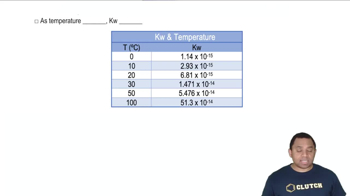
The temperature dependence of reaction rates indicates that as temperature increases, the rate of reaction generally increases due to higher molecular motion and collision frequency. However, the extent of this increase can vary between forward and reverse reactions, depending on their respective activation energies. Understanding this relationship is crucial for predicting how changes in temperature will affect k_f and k_r.
추천 영상:
가이드 코스
01:24
Kw Temperature Dependence