
Ch.15 - Chemical Equilibrium
Brown - Chemistry: The Central Science 15th Edition
Brown15th EditionChemistry: The Central ScienceISBN: 9780137542970당신이 사용하는 게 아니라요?교과서 변경
15장, 문제 3

Consider the equilibrium Na2O(s) + SO2(g) ⇌ Na2SO3(s). (a) Write the equilibrium-constant expression for this reaction in terms of partial pressures. (b) All the compounds in this reaction are soluble in water. Rewrite the equilibrium-constant expression in terms of molarities for the aqueous reaction.

검증된 단계별 안내
1
Step 1: Identify the phases of each compound in the reaction. Na2O is a solid, SO2 is a gas, and Na2SO3 is a solid.
Step 2: Write the equilibrium-constant expression for the reaction in terms of partial pressures. Since solids do not appear in the expression, only the gaseous component, SO2, is included. The expression is K_p = 1/P_{SO2}.
Step 3: Consider the aqueous reaction where all compounds are soluble in water. In this case, all species are in the aqueous phase, and we use molarities to express the equilibrium constant.
Step 4: Write the equilibrium-constant expression for the aqueous reaction in terms of molarities. The expression is K_c = [Na2SO3]/([Na2O][SO2]).
Step 5: Note that in the aqueous expression, the concentration of solids is typically considered constant and thus omitted, simplifying the expression to K_c = 1/[SO2].

주요 개념

질문에 올바르게 답하기 위해 반드시 이해해야 하는 핵심 개념들은 다음과 같습니다.

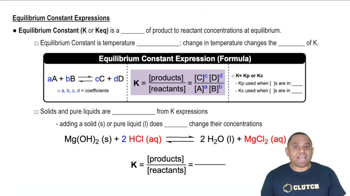
Equilibrium Constant Expression

The equilibrium constant expression quantifies the ratio of the concentrations (or partial pressures) of products to reactants at equilibrium. For gaseous reactions, it is expressed in terms of partial pressures, while for reactions in solution, it is expressed in terms of molarity. The general form is K = [products]^[coefficients] / [reactants]^[coefficients], where square brackets denote concentration or pressure.
추천 영상:
가이드 코스
03:20
Equilibrium Constant Expressions

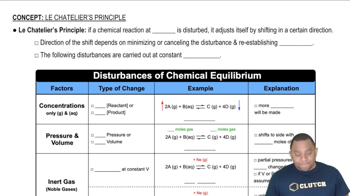
Le Chatelier's Principle

Le Chatelier's Principle states that if a dynamic equilibrium is disturbed by changing the conditions, the system will adjust to counteract the change and restore a new equilibrium. This principle helps predict how changes in concentration, pressure, or temperature will affect the position of equilibrium in a chemical reaction.
추천 영상:
가이드 코스
07:32
Le Chatelier's Principle

Solubility and Aqueous Equilibria

Solubility refers to the ability of a substance to dissolve in a solvent, forming a solution. In aqueous equilibria, the concentrations of dissolved species are used to express the equilibrium constant. When all reactants and products are soluble, the equilibrium expression is written in terms of molarity, reflecting the concentrations of the ions or molecules in solution.
추천 영상:
가이드 코스
01:11
Types of Aqueous Solutions
관련 실천
교과서 질문

Ethene (C2H4) reacts with halogens (X2) by the following reaction:

C2H4(𝑔) + X2(𝑔) ⇌ C2H4X2(𝑔)

The following figures represent the concentrations at equilibrium at the same temperature when X2 is Cl2 (green), Br2 (brown), and I2 (purple). List the equilibria from smallest to largest equilibrium constant. [Section 15.3]

491
views
교과서 질문

The following diagrams represent a hypothetical reaction A ¡ B, with A represented by red spheres and B represented by blue spheres. The sequence from left to right represents the system as time passes. Does the system reach equilibrium? If so, in which diagram(s) is the system in equilibrium? [Sections 15.1 and 15.2]

1112
views
교과서 질문

When lead(IV) oxide is heated above 300°C, it decomposes according to the reaction, 2 PbO2(𝑠) ⇌ 2PbO(𝑠) + O2(𝑔). Consider the two sealed vessels of PbO2 shown here. If both vessels are heated to 400°C and allowed to come to equilibrium, which of the following statements is or are true? a. There will be less PbO2 remaining in vessel A than in vessel B.

교과서 질문

The following diagram represents a reaction shown going to completion. Each molecule in the diagram represents 0.1 mol, and the volume of the box is 1.0 L. (d) Assuming that all of the molecules are in the gas phase, calculate n, the change in the number of gas molecules that accompanies the reaction. [Section 15.2]

600
views
교과서 질문

(a) Based on the following energy profile, predict whether kf > kr or kf < kr. [Section 15.1]

551
views