
Ch.15 - Chemical Equilibrium
15์žฅ, ๋ฌธ์ œ 77c

Consider the hypothetical reaction A(๐‘”) โ‡Œ 2 B(๐‘”). A flask is charged with 0.75 atm of pure A, after which it is allowed to reach equilibrium at 0ยฐC. At equilibrium, the partial pressure of A is 0.36 atm. (c) To maximize the yield of product B, would you make the reaction flask larger or smaller?

๊ฒ€์ฆ๋œ ๋‹จ๊ณ„๋ณ„ ์•ˆ๋‚ด
1
insert step 1> Identify the reaction: A(g) โ‡Œ 2 B(g). This is a gaseous equilibrium reaction where A is converted to B.
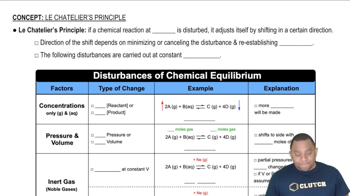
insert step 2> Understand the concept of Le Chatelier's Principle: It states that if a dynamic equilibrium is disturbed by changing the conditions, the position of equilibrium shifts to counteract the change.
insert step 3> Consider the effect of volume change on equilibrium: Increasing the volume of the container decreases the pressure, favoring the side with more moles of gas. Conversely, decreasing the volume increases the pressure, favoring the side with fewer moles of gas.
insert step 4> Analyze the reaction: The reaction A(g) โ‡Œ 2 B(g) has 1 mole of A converting to 2 moles of B. Increasing the volume will favor the formation of more moles of gas, thus shifting the equilibrium towards the products (B).
insert step 5> Conclusion: To maximize the yield of product B, you should make the reaction flask larger, as this will shift the equilibrium towards the side with more moles of gas (2 B).

๋น„์Šทํ•œ ๋ฌธ์ œ์— ๋Œ€ํ•œ ๊ฒ€์ฆ๋œ ์˜์ƒ ๋‹ต๋ณ€:

์ด ์˜์ƒ ํ•ด๋ฒ•์€ ์œ„ ๋ฌธ์ œ์— ๋„์›€์ด ๋œ๋‹ค๊ณ  ํŠœํ„ฐ๋“ค์ด ์ถ”์ฒœํ•œ ๊ฒƒ์ž…๋‹ˆ๋‹ค.
์˜์ƒ ๊ธธ์ด:
4m

์ฃผ์š” ๊ฐœ๋…

์งˆ๋ฌธ์— ์˜ฌ๋ฐ”๋ฅด๊ฒŒ ๋‹ตํ•˜๊ธฐ ์œ„ํ•ด ๋ฐ˜๋“œ์‹œ ์ดํ•ดํ•ด์•ผ ํ•˜๋Š” ํ•ต์‹ฌ ๊ฐœ๋…๋“ค์€ ๋‹ค์Œ๊ณผ ๊ฐ™์Šต๋‹ˆ๋‹ค.

Le Chatelier's Principle

Le Chatelier's Principle states that if a dynamic equilibrium is disturbed by changing the conditions, the position of equilibrium shifts to counteract the change. In the context of the reaction A(g) โ‡Œ 2B(g), if the volume of the flask is altered, it affects the partial pressures of the gases, thereby influencing the equilibrium position and the yield of products.
์ถ”์ฒœ ์˜์ƒ:

Equilibrium Constant (Kp)

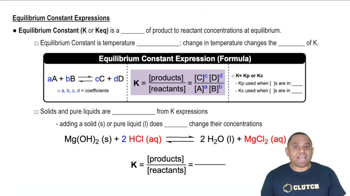
The equilibrium constant (Kp) for a gaseous reaction is defined in terms of the partial pressures of the reactants and products at equilibrium. For the reaction A(g) โ‡Œ 2B(g), Kp can be expressed as Kp = (P_B^2) / (P_A). Understanding Kp helps predict how changes in pressure or volume will affect the concentrations of A and B at equilibrium.
์ถ”์ฒœ ์˜์ƒ:
๊ฐ€์ด๋“œ ์ฝ”์Šค
03:20
Equilibrium Constant Expressions

Effect of Volume on Gas Equilibrium

Changing the volume of a reaction flask affects the partial pressures of gases involved in the reaction. Reducing the volume increases the pressure, favoring the side of the reaction with fewer moles of gas. In this case, since there are 2 moles of B produced for every mole of A consumed, decreasing the volume would shift the equilibrium towards producing more B, thus maximizing its yield.
์ถ”์ฒœ ์˜์ƒ:
๊ด€๋ จ ์‹ค์ฒœ