
교과서 질문
Indicate whether each of the following statements about the reaction quotient Q is true or false: (b) If 𝑄𝑐 < 𝐾𝑐, the reaction needs to proceed to the right to reach equilibrium.

 검증된 단계별 안내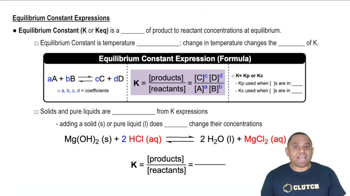
 03:20
03:20
 00:53
00:53 01:16
01:16Indicate whether each of the following statements about the reaction quotient Q is true or false: (b) If 𝑄𝑐 < 𝐾𝑐, the reaction needs to proceed to the right to reach equilibrium.
Indicate whether each of the following statements about the reaction quotient Q is true or false: (a) The expression for 𝑄𝑐 looks the same as the expression for 𝐾𝑐.
At 100°C, the equilibrium constant for the reaction COCl2(𝑔) ⇌ CO(𝑔) + Cl2(𝑔) has the value 𝐾𝑐 = 2.19×10⁻¹⁰. Are the following mixtures of COCl2, CO, and Cl2 at 100°C at equilibrium? If not, indicate the direction that the reaction must proceed to achieve equilibrium.
(a) [COCl2] = 2.00×10⁻³ M, [CO] = 3.3×10⁻⁶ M, [Cl2] = 6.62×10⁻⁶ M
(b) [COCl2] = 4.50×10⁻² M, [CO] = 1.1×10⁻⁷ M, [Cl2] = 2.25×10⁻⁶ M
(c) [COCl2] = 0.0100 M, [CO] = [Cl2] = 1.48×10⁻⁶ M
A mixture of 0.2000 mol of CO2, 0.1000 mol of H2, and 0.1600 mol of H2O is placed in a 2.000-L vessel. The following equilibrium is established at 500 K: CO2(g) + H2(g) ⇌ CO(g) + H2O(g) (d) Calculate Kc for the reaction.