Ch.16 - Acid-Base Equilibria
Brown - Chemistry: The Central Science 15th Edition
Brown15th EditionChemistry: The Central ScienceISBN: 9780137542970당신이 사용하는 게 아니라요?교과서 변경
16장, 문제 100

A solution is made by adding 0.300 g Ca1OH221s2, 50.0 mL of 1.40 M HNO3, and enough water to make a final volume of 75.0 mL. Assuming that all of the solid dissolves, what is the pH of the final solution?

검증된 단계별 안내
1
Calculate the moles of Ca(OH)_2 using its molar mass.
Determine the moles of HNO_3 using its concentration and volume.
Write the balanced chemical equation for the reaction: Ca(OH)_2 + 2HNO_3 -> Ca(NO_3)_2 + 2H_2O.
Calculate the moles of H^+ ions remaining after the reaction, considering the stoichiometry of the reaction.
Use the concentration of remaining H^+ ions in the final solution volume to find the pH using the formula: pH = -log[H^+].

비슷한 문제에 대한 검증된 영상 답변:

이 영상 해법은 위 문제에 도움이 된다고 튜터들이 추천한 것입니다.
영상 길이:
6m

주요 개념

질문에 올바르게 답하기 위해 반드시 이해해야 하는 핵심 개념들은 다음과 같습니다.

Dissociation of Calcium Hydroxide

Calcium hydroxide, Ca(OH)2, is a strong base that dissociates completely in water to produce calcium ions (Ca²⁺) and hydroxide ions (OH⁻). The dissociation reaction can be represented as Ca(OH)2 → Ca²⁺ + 2OH⁻. Understanding this dissociation is crucial for determining the concentration of hydroxide ions in the solution, which directly affects the pH.
추천 영상:
가이드 코스
06:12
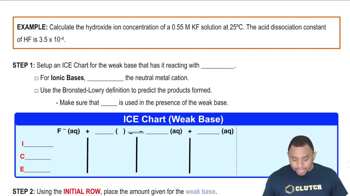
Hydroxide Ion Concentration Example

Strong Acid-Base Neutralization

In this scenario, nitric acid (HNO3) is a strong acid that also dissociates completely in solution to yield hydrogen ions (H⁺). The reaction between the hydroxide ions from calcium hydroxide and the hydrogen ions from nitric acid leads to neutralization, forming water. The stoichiometry of this reaction is essential for calculating the resulting concentrations of H⁺ and OH⁻ ions, which ultimately determines the pH of the solution.
추천 영상:
가이드 코스
01:09
Strong Acid-Strong Base Titration

pH Calculation

pH is a measure of the acidity or basicity of a solution, defined as the negative logarithm of the hydrogen ion concentration: pH = -log[H⁺]. In a neutralization reaction, the final pH depends on the relative amounts of H⁺ and OH⁻ ions present after the reaction. If there is an excess of H⁺, the solution will be acidic (pH < 7), while an excess of OH⁻ will result in a basic solution (pH > 7).
추천 영상:
가이드 코스
02:15
pH Calculation Example
관련 실천
교과서 질문

Calculate the pH of a solution made by adding 2.50 g of lithium oxide 1Li2O2 to enough water to make 1.500 L of solution.

390
views

교과서 질문

Which, if any, of the following statements are true? (a) The stronger the base, the smaller the pKb. (b) The stronger the base, the larger the pKb. (c) The stronger the base, the smaller the Kb. (d) The stronger the base, the larger the Kb. (e) The stronger the base, the smaller the pKa of its conjugate acid. (f) The stronger the base, the larger the pKa of its conjugate acid.

1825
views
교과서 질문

Indicate whether each of the following statements is correct or incorrect. (c) Conjugate acids of weak bases produce more acidic solutions than conjugate acids of strong bases.

268
views
교과서 질문

Indicate whether each of the following statements is true or false. For each statement that is false, correct the statement to make it true. (a) Acid strength in a series of H¬A molecules increases with increasing size of A. (b) For acids of the same general structure but differing electronegativities of the central atoms, acid strength decreases with increasing electronegativity of the central atom. (c) The strongest acid known is HF because fluorine is the most electronegative element.

633
views
교과서 질문

Predict how each molecule or ion would act, in the Brønsted-Lowry sense, in aqueous solution by writing 'acid,' 'base,' 'both,' or 'neither' on the line provided. (b) Prozac

408
views
교과서 질문

Indicate whether each of the following statements is correct or incorrect. (d) K+ ion is acidic in water because it causes hydrating water molecules to become more acidic.

330
views