
Ch.16 - Acid-Base Equilibria
Brown - Chemistry: The Central Science 15th Edition
Brown15th EditionChemistry: The Central ScienceISBN: 9780137542970당신이 사용하는 게 아니라요?교과서 변경
16장, 문제 19

Give the conjugate base of the following Brønsted–Lowry acids: (i) HIO3, (ii) NH4+.

검증된 단계별 안내
1
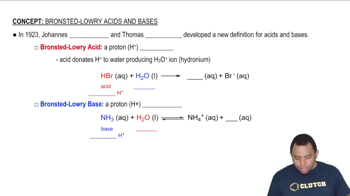
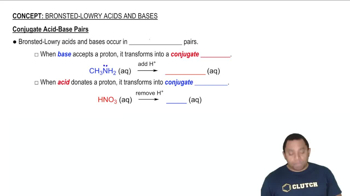
1. A Brønsted-Lowry acid is a substance that donates a proton (H+) in a chemical reaction. The conjugate base of an acid is formed when the acid donates a proton. Therefore, to find the conjugate base of a Brønsted-Lowry acid, we simply need to remove a proton (H+) from the acid.
2. For HIO3, remove one H+ to get the conjugate base. The conjugate base of HIO3 is IO3-.
3. For NH4+, remove one H+ to get the conjugate base. The conjugate base of NH4+ is NH3.
4. Remember, the charge of the conjugate base will be one unit less than the charge of the acid, since a positively charged proton has been removed.
5. So, the conjugate bases of HIO3 and NH4+ are IO3- and NH3 respectively.

비슷한 문제에 대한 검증된 영상 답변:

이 영상 해법은 위 문제에 도움이 된다고 튜터들이 추천한 것입니다.
영상 길이:
2m

주요 개념

질문에 올바르게 답하기 위해 반드시 이해해야 하는 핵심 개념들은 다음과 같습니다.

Brønsted–Lowry Acid-Base Theory

The Brønsted–Lowry theory defines acids as proton donors and bases as proton acceptors. This framework emphasizes the transfer of protons (H+) in chemical reactions, allowing for a broader understanding of acid-base behavior beyond just the presence of hydroxide ions. This theory is essential for identifying conjugate acid-base pairs.
추천 영상:
가이드 코스
02:08
Bronsted-Lowry Acid-Base Theory

Conjugate Acid-Base Pairs

A conjugate base is formed when an acid donates a proton. In a conjugate acid-base pair, the acid and its conjugate base differ by one proton. Understanding this relationship is crucial for predicting the products of acid-base reactions and for identifying the conjugate base of a given acid.
추천 영상:
가이드 코스
01:30
Conjugate Acid-Base Pairs

Dissociation of Acids

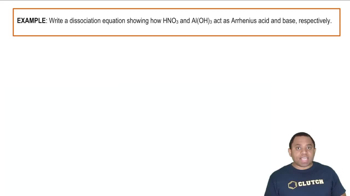
The dissociation of acids involves the release of protons into solution, which is a key step in determining their conjugate bases. For example, when HIO3 dissociates, it loses a proton to form IO3-, while NH4+ dissociates to form NH3. Recognizing how acids dissociate helps in identifying their corresponding conjugate bases.
추천 영상:
가이드 코스
00:54
Acid-Base Dissociation Example
관련 실천
교과서 질문

Which of the following statements is false? (a) An Arrhenius base increases the concentration of OH- in water. (b) A Brønsted-Lowry base is a proton acceptor. (c) Water can act as a Brønsted–Lowry acid. (d) Water can act as a Brønsted–Lowry base. (e) Any compound that contains an –OH group acts as a Brønsted-Lowry base.

519
views
교과서 질문

Give the conjugate base of the following Brønsted–Lowry acids: (i) HCOOH, (ii) HPO42-.

511
views
교과서 질문

Identify the Brønsted–Lowry acid and the Brønsted–Lowry base on the left side of each of the following equations, and also identify the conjugate acid and conjugate base of each on the right side:

(a) NH4+(aq) + CN-(aq) ⇌ HCN(aq) + NH3(aq)

(b) (CH3)3N(aq) + H2O(l) ⇌ (CH3)3NH+(aq) + OH-(aq)

(c) HCOOH(aq) + PO43-(aq) ⇌ HCOO-(aq)+ HPO42-(aq)

295
views
교과서 질문

Give the conjugate acid of the following Brønsted–Lowry bases: (i) SO42-, (ii) CH3NH2.

537
views
교과서 질문

Identify the Lewis acid and Lewis base among the reactants in each of the following reactions:

(a) Fe(ClO4)3(s) + 6 H2O(l) ⇌ [Fe(H2O)6]3+(aq) + 3 ClO4-(aq)

(b) CN-(aq) + H2O(l) ⇌ HCN(aq) + OH-(aq)

(c) (CH3)3N(g) + BF3(g) ⇌ (CH3)NBF3(s)

(d) HIO(lq) + NH2-(lq) ⇌ NH3(lq) + IO-(lq) (lq denotes liquid ammonia as solvent)

474
views
교과서 질문

Identify the Lewis acid and Lewis base in each of the following reactions:

(a) HNO2(aq) + OH-(aq) ⇌ NO2-(aq) + H2O(l)

(b) FeBr3(s) + Br-(aq) ⇌ FeBr4-(aq)

(c) Zn2+(aq) + 4 NH3(aq) ⇌ Zn(NH3)42+(aq)

(d) SO2(g) + H2O(l) ⇌ H2SO3(aq)

1152
views