An unknown salt is either KBr, NH4Cl, KCN, or K2CO3. If a 0.100 M solution of the salt is neutral, what is the identity of the salt?
Ch.16 - Acid-Base Equilibria

16장, 문제 93
Predict the stronger acid in each pair: (a) HNO3 or HNO2 (b) H2SO4 or H2SeO4 (c) CH3COOH or CCl3COOH.
검증된 단계별 안내1
Step 1: Understand the concept of acid strength. Acid strength is determined by the ability of an acid to donate a proton (H+). The more easily an acid donates a proton, the stronger it is.
Step 2: Analyze the molecular structure and electronegativity for each pair. For (a) HNO3 vs. HNO2, consider the number of oxygen atoms and their effect on the stability of the conjugate base. More oxygen atoms generally stabilize the conjugate base through resonance, making the acid stronger.
Step 3: For (b) H2SO4 vs. H2SeO4, compare the central atoms (S vs. Se). Sulfur is more electronegative than selenium, which can lead to a stronger acid due to better stabilization of the conjugate base.
Step 4: For (c) CH3COOH vs. CCl3COOH, examine the effect of substituents on the carboxylic acid group. The presence of electronegative chlorine atoms in CCl3COOH increases the acid strength by stabilizing the conjugate base through inductive effects.
Step 5: Conclude by identifying the stronger acid in each pair based on the analysis of molecular structure, electronegativity, and resonance or inductive effects.
주요 개념
질문에 올바르게 답하기 위해 반드시 이해해야 하는 핵심 개념들은 다음과 같습니다.
Acid Strength and Ionization
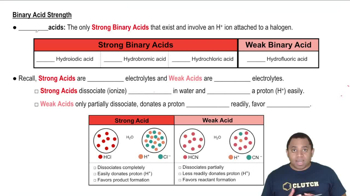
The strength of an acid is determined by its ability to donate protons (H+) in solution. Strong acids completely ionize in water, releasing all their protons, while weak acids only partially ionize. The extent of ionization is influenced by the stability of the resulting conjugate base; more stable conjugate bases correspond to stronger acids.
추천 영상:
가이드 코스
Binary Acid Strengths
Electronegativity and Inductive Effect
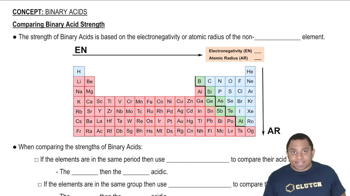
Electronegativity refers to the tendency of an atom to attract electrons. In acids, electronegative atoms can stabilize the negative charge of the conjugate base through the inductive effect, which enhances acid strength. For example, in halogenated acids, the presence of electronegative halogens can increase acidity by stabilizing the conjugate base.
추천 영상:
가이드 코스
Electronegativity Trends
Comparative Acid Strength in Oxoacids
In oxoacids, the number of oxygen atoms bonded to the central atom significantly affects acidity. More oxygen atoms generally lead to greater acid strength due to increased resonance stabilization of the conjugate base. Thus, when comparing oxoacids, the one with more oxygen atoms typically exhibits stronger acidic properties.
추천 영상:
가이드 코스
Comparing Binary Acid Strength
관련 실천
교과서 질문
640
views
교과서 질문
An unknown salt is either NaF, NaCl, or NaOCl. When 0.050 mol of the salt is dissolved in water to form 0.500 L of solution, the pH of the solution is 8.08. What is the identity of the salt?
864
views
교과서 질문
Predict the stronger acid in each pair: (c) HBrO3 or HBrO2
1479
views
교과서 질문
Based on their compositions and structures and on conjugate acid–base relationships, select the stronger base in each of the following pairs: (b) BrO- or BrO2-
929
views
교과서 질문
Which member of each pair produces the more acidic aqueous solution: (a) ZnBr2 or CdCl2 (b) CuCl or Cu(NO3)2 (c) Ca(NO3)2 or NiBr2
472
views
교과서 질문
Predict the stronger acid in each pair: (e) benzoic acid (C6H5COOH) or phenol (C6H5OH).
1167
views