Write the chemical equation and the Kb expression for the reaction of each of the following bases with water: (a) propylamine, C3H7NH2
Ch.16 - Acid-Base Equilibria

16장, 문제 72c
The hypochlorite ion, ClO-, acts as a weak base. (b) When ClO- acts as a base, which atom, Cl or O, acts as the proton acceptor? (c) Can you use formal charges to rationalize your answer to part (b)?
검증된 단계별 안내1
insert step 1> Identify the role of the hypochlorite ion (ClO-) as a base, which means it will accept a proton (H+).
insert step 2> Consider the structure of the hypochlorite ion: Cl is bonded to O, and O has a lone pair of electrons.
insert step 3> Determine which atom, Cl or O, is more likely to accept a proton. Oxygen is more electronegative than chlorine and has lone pairs, making it a better candidate for proton acceptance.
insert step 4> Use formal charges to rationalize: In ClO-, the formal charge on O is typically -1, while Cl is 0. The negative charge on O indicates a higher electron density, making it more likely to attract and accept a proton.
insert step 5> Conclude that the oxygen atom in ClO- acts as the proton acceptor due to its higher electronegativity and negative formal charge.

비슷한 문제에 대한 검증된 영상 답변:
이 영상 해법은 위 문제에 도움이 된다고 튜터들이 추천한 것입니다.
영상 길이:
1m도움이 되었나요?
주요 개념
질문에 올바르게 답하기 위해 반드시 이해해야 하는 핵심 개념들은 다음과 같습니다.
Acid-Base Theory
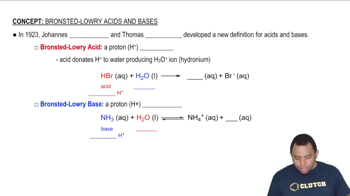
Acid-base theory explains the behavior of substances in terms of proton transfer. According to the Brønsted-Lowry definition, an acid is a proton donor, while a base is a proton acceptor. In the case of the hypochlorite ion (ClO-), understanding its role as a weak base is crucial for determining which atom accepts the proton during a reaction.
추천 영상:
가이드 코스
Bronsted-Lowry Acid-Base Theory
Proton Acceptor
In the context of acid-base reactions, the proton acceptor is the species that gains a hydrogen ion (H+). For the hypochlorite ion, the oxygen atom is typically the site of protonation due to its higher electronegativity compared to chlorine. This property allows oxygen to stabilize the positive charge that results from accepting a proton, making it the more likely proton acceptor.
추천 영상:
가이드 코스
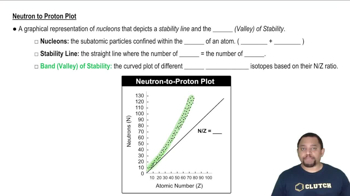
Neutron-to-Proton Plot
Formal Charge
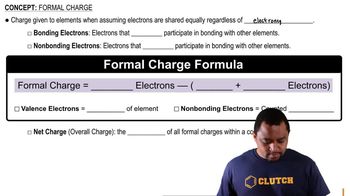
Formal charge is a theoretical concept used to determine the distribution of electrons in a molecule. It is calculated by comparing the number of valence electrons in an atom to the number of electrons it owns in a Lewis structure. In the case of ClO-, analyzing formal charges can help rationalize which atom (Cl or O) is more stable after protonation, thus supporting the identification of the proton acceptor.
추천 영상:
가이드 코스
Formal Charge
관련 실천
교과서 질문
752
views
교과서 질문
Citric acid, which is present in citrus fruits, is a triprotic acid (Table 16.3). (a) Calculate the pH of a 0.040 M solution of citric acid. (b) Did you have to make any approximations or assumptions in completing your calculations? (c) Is the concentration of citrate ion 1C6H5O7 3-2 equal to, less than, or greater than the H+ ion concentration?
1670
views
교과서 질문
Consider the base hydroxylamine, NH2OH. (a) What is the conjugate acid of hydroxylamine?
1199
views
교과서 질문
The hypochlorite ion, ClO-, acts as a weak base. (a) Is ClO- a stronger or weaker base than hydroxylamine?
2024
views
교과서 질문
Write the chemical equation and the Kb expression for the reaction of each of the following bases with water: (c) benzoate ion, C6H5CO2-
512
views