
A sample of 0.1687 g of an unknown monoprotic acid was dissolved in 25.0 mL of water and titrated with 0.1150 M NaOH. The acid required 15.5 mL of base to reach the equivalence point. (b) After 7.25 mL of base had been added in the titration, the pH was found to be 2.85. What is the Ka for the unknown acid?
Ch.17 - Additional Aspects of Aqueous Equilibria

17장, 문제 95
Suppose you want to do a physiological experiment that calls for a pH 6.50 buffer. You find that the organism with which you are working is not sensitive to the weak acid H2A 1Ka1 = 2 * 10-2; Ka2 = 5.0 * 10-72 or its sodium salts. You have available a 1.0 M solution of this acid and a 1.0 M solution of NaOH. How much of the NaOH solution should be added to 1.0 L of the acid to give a buffer at pH 6.50? (Ignore any volume change.)
검증된 단계별 안내1
Identify the relevant equilibrium for the buffer system. Since the desired pH is 6.50, which is closer to the second pKa (7.2), use the second dissociation equilibrium: \( H_2A^- \rightleftharpoons HA^{2-} + H^+ \).
Use the Henderson-Hasselbalch equation for the second dissociation: \( \text{pH} = \text{pKa}_2 + \log \left( \frac{[HA^{2-}]}{[H_2A^-]} \right) \).
Substitute the given pH (6.50) and \( \text{pKa}_2 \) (7.2) into the Henderson-Hasselbalch equation to find the ratio \( \frac{[HA^{2-}]}{[H_2A^-]} \).
Calculate the moles of \( H_2A^- \) initially present in 1.0 L of 1.0 M \( H_2A \), which is 1.0 mol.
Determine the moles of NaOH needed to achieve the desired ratio by using the stoichiometry of the reaction \( H_2A^- + OH^- \rightarrow HA^{2-} + H_2O \), and solve for the volume of 1.0 M NaOH solution required.

비슷한 문제에 대한 검증된 영상 답변:
이 영상 해법은 위 문제에 도움이 된다고 튜터들이 추천한 것입니다.
영상 길이:
7m주요 개념
질문에 올바르게 답하기 위해 반드시 이해해야 하는 핵심 개념들은 다음과 같습니다.
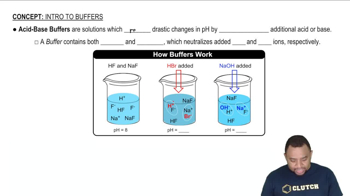
Buffer Solutions
A buffer solution is a system that resists changes in pH upon the addition of small amounts of acid or base. It typically consists of a weak acid and its conjugate base or a weak base and its conjugate acid. In this case, the weak acid H2A and its sodium salt will help maintain the desired pH of 6.50 when NaOH is added.
추천 영상:
가이드 코스
Buffer Solutions
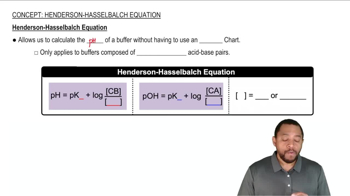
Henderson-Hasselbalch Equation
The Henderson-Hasselbalch equation relates the pH of a buffer solution to the concentration of its acid and conjugate base. It is expressed as pH = pKa + log([A-]/[HA]), where pKa is the negative logarithm of the acid dissociation constant (Ka). This equation is essential for calculating the required amounts of acid and base to achieve a specific pH.
추천 영상:
가이드 코스
Henderson-Hasselbalch Equation
Acid-Base Neutralization
Acid-base neutralization is a chemical reaction where an acid reacts with a base to produce water and a salt. In this scenario, adding NaOH (a strong base) to the weak acid H2A will neutralize some of the acid, forming its conjugate base and adjusting the pH of the solution. Understanding this reaction is crucial for determining how much NaOH is needed to reach the target pH.
추천 영상:
가이드 코스
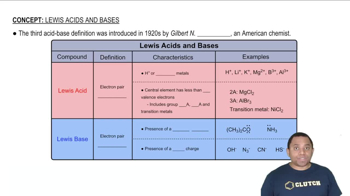
Lewis Acids and Bases
관련 실천
교과서 질문
2137
views
1
rank
교과서 질문
For each pair of compounds, use Ksp values to determine which has the greater molar solubility: (a) CdS or CuS (b) PbCO3 or BaCrO4 (c) Ni(OH)2 or NiCO3 (d) AgI or Ag2SO4.
773
views
교과서 질문
Lead(II) carbonate, PbCO3, is one of the components of the passivating layer that forms inside lead pipes. (d) The EPA threshold for acceptable levels of lead ions in water is 15 ppb. Does a saturated solution of lead(II) carbonate produce a solution that exceeds the EPA limit?
1153
views
