
Ch.17 - Additional Aspects of Aqueous Equilibria
Brown - Chemistry: The Central Science 15th Edition
Brown15th EditionChemistry: The Central ScienceISBN: 9780137542970당신이 사용하는 게 아니라요?교과서 변경
17장, 문제 33d

The accompanying graph shows the titration curves for two monoprotic acids. (d) Estimate the pKa of the weak acid.
Graph showing titration curves of two monoprotic acids labeled A and B.

검증된 단계별 안내
1
Identify the titration curve for the weak acid. In this case, it is curve B.
Locate the midpoint of the titration curve for the weak acid. This is the point where half of the acid has been neutralized.
At the midpoint, the pH of the solution is equal to the pKa of the weak acid.
Estimate the pH value at the midpoint of curve B by finding the volume of base added at the equivalence point and then halving it.
Read the pH value at this midpoint volume from the graph, which will give you the estimated pKa of the weak acid.

비슷한 문제에 대한 검증된 영상 답변:

이 영상 해법은 위 문제에 도움이 된다고 튜터들이 추천한 것입니다.
영상 길이:
2m

주요 개념

질문에 올바르게 답하기 위해 반드시 이해해야 하는 핵심 개념들은 다음과 같습니다.

Titration Curves

Titration curves graphically represent the change in pH of a solution as a titrant is added. For monoprotic acids, the curve typically shows a gradual increase in pH followed by a steep rise at the equivalence point, where the acid is neutralized. The shape of the curve provides insights into the acid's strength and the pKa value, which is crucial for estimating the acid's dissociation constant.
추천 영상:
가이드 코스
02:16
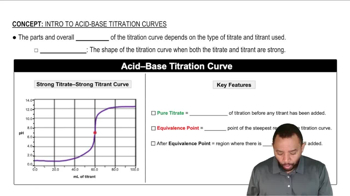
Acid-Base Titration Curves

pKa and Acid Strength

The pKa is the negative logarithm of the acid dissociation constant (Ka) and indicates the strength of an acid. A lower pKa value signifies a stronger acid, as it dissociates more readily in solution. In titration curves, the pKa can be estimated from the midpoint of the steepest section of the curve, where the concentrations of the acid and its conjugate base are equal.
추천 영상:
가이드 코스
03:51
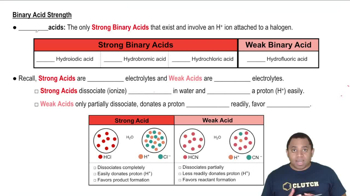
Binary Acid Strengths

Monoprotic Acids

Monoprotic acids are acids that can donate only one proton (H+) per molecule during dissociation. This characteristic simplifies their titration analysis, as the pH change can be directly correlated to the amount of base added. Understanding the behavior of monoprotic acids in titrations is essential for accurately determining their pKa values and assessing their strength.
추천 영상:
관련 실천
교과서 질문

The samples of nitric and acetic acids shown here are both titrated with a 0.100 M solution of NaOH(aq).

Determine whether each of the following statements concerning these titrations is true or false. (a) A larger volume of NaOH1aq2 is needed to reach the equivalence point in the titration of HNO3.

673
views
교과서 질문

You have to prepare a pH = 3.50 buffer, and you have the following 0.10 M solutions available: HCOOH, CH3COOH, H3PO4, HCOONa, CH3COONa, and NaH2PO4. How many milliliters of each solution would you use to make approximately 1 L of the buffer?

교과서 질문

Compare the titration of a strong, monoprotic acid with a strong base to the titration of a weak, monoprotic acid with a strong base. Assume the strong and weak acid solutions initially have the same concentrations. Indicate whether the following statements are true or false. (a) More base is required to reach the equivalence point for the strong acid than the weak acid.

1095
views
1
rank
교과서 질문

You have to prepare a pH = 5.00 buffer, and you have the following 0.10 M solutions available: HCOOH, HCOONa, CH3COOH, CH3COONa, HCN, and NaCN. How many milliliters of each solution would you use to make approximately 1 L of the buffer?

2216
views
교과서 질문

Determine whether each of the following statements concerning the titrations in Problem 17.35 is true or false. b. Both titration curves will be essentially the same after passing the equivalence point.

교과서 질문

You have to prepare a pH = 5.00 buffer, and you have the following 0.10 M solutions available: HCOOH, HCOONa, CH3COOH, CH3COONa, HCN, and NaCN. Which solutions would you use?

747
views