
Ch.19 - Chemical Thermodynamics
Brown - Chemistry: The Central Science 15th Edition
Brown15th EditionChemistry: The Central ScienceISBN: 9780137542970당신이 사용하는 게 아니라요?교과서 변경
19장, 문제 17c

A system goes from state 1 to state 2 and back to state 1 following a reversible path in both directions. Which of the following statements about this process is or are true?
c. The value of w on going from state 1 to state 2 is equal in magnitude and opposite in sign to the value of w on going from state 2 back to state 1.

검증된 단계별 안내
1
Identify that the process described is a reversible cycle, meaning the system returns to its initial state.
Recall that in a reversible process, the work done (w) is path-dependent but the net change in state functions like internal energy (U) is zero over a complete cycle.
Understand that for a reversible cycle, the work done from state 1 to state 2 (w_1→2) and the work done from state 2 back to state 1 (w_2→1) must sum to zero because the system returns to its original state.
Express this mathematically as w_1→2 + w_2→1 = 0, which implies that w_1→2 = -w_2→1.
Conclude that the statement is true: the work done from state 1 to state 2 is equal in magnitude and opposite in sign to the work done from state 2 back to state 1.

비슷한 문제에 대한 검증된 영상 답변:

이 영상 해법은 위 문제에 도움이 된다고 튜터들이 추천한 것입니다.
영상 길이:
1m
도움이 되었나요?

주요 개념

질문에 올바르게 답하기 위해 반드시 이해해야 하는 핵심 개념들은 다음과 같습니다.

Reversible Processes

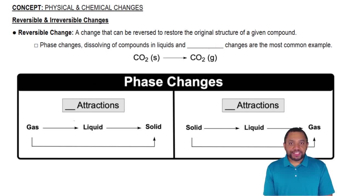
A reversible process is a thermodynamic process that can be reversed without leaving any trace on the surroundings. In such processes, the system and surroundings can be returned to their original states. This concept is crucial for understanding how energy and work are exchanged in a system, as it implies that the system can undergo changes in a controlled manner, allowing for the analysis of work done in both directions.
추천 영상:
가이드 코스
03:42
Reversible Changes in Matter

Work in Thermodynamics

In thermodynamics, work (denoted as 'w') is defined as the energy transferred when a force is applied over a distance. The sign of work is important: work done by the system on the surroundings is considered negative, while work done on the system is positive. Understanding this concept is essential for analyzing energy changes during reversible processes, particularly in determining the relationship between work done in both directions of a reversible path.
추천 영상:
가이드 코스
01:18
First Law of Thermodynamics

First Law of Thermodynamics

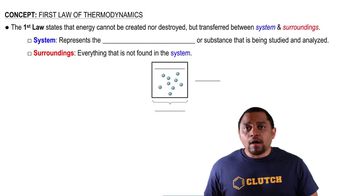
The First Law of Thermodynamics states that energy cannot be created or destroyed, only transformed from one form to another. This principle implies that the total energy change in a system is equal to the heat added to the system minus the work done by the system. In the context of reversible processes, this law helps to establish the relationship between the work done in both directions, reinforcing the idea that the work done going from state 1 to state 2 is equal in magnitude and opposite in sign to that going back.
추천 영상:
가이드 코스
01:18
First Law of Thermodynamics