
Ch.19 - Chemical Thermodynamics
Brown - Chemistry: The Central Science 15th Edition
Brown15th EditionChemistry: The Central ScienceISBN: 9780137542970당신이 사용하는 게 아니라요?교과서 변경
19장, 문제 103a

Consider the following equilibrium: N2O4(g) ⇌ 2 NO2(g) Thermodynamic data on these gases are given in Appendix C. You may assume that ΔH° and ΔS° do not vary with temperature. (a) At what temperature will an equilibrium mixture contain equal amounts of the two gases?

검증된 단계별 안내
1
Identify the expression for the equilibrium constant, K, for the reaction: N2O4(g) ⇌ 2 NO2(g). The equilibrium constant can be expressed as K = [NO2]2 / [N2O4].
Set up the equation for the Gibbs free energy change (ΔG°) in terms of the standard enthalpy change (ΔH°) and the standard entropy change (ΔS°) at temperature T: ΔG° = ΔH° - TΔS°.
Relate ΔG° to the equilibrium constant K using the relationship ΔG° = -RT ln(K), where R is the gas constant and T is the temperature in Kelvin.
Combine the equations from steps 2 and 3 to solve for T when K = 1 (since at K = 1, the concentrations of N2O4 and NO2 are equal). This gives the equation: ΔH° - TΔS° = -RT ln(1). Since ln(1) = 0, simplify to ΔH° = TΔS°.
Solve for T by rearranging the equation from step 4: T = ΔH° / ΔS°. Use the values of ΔH° and ΔS° from the thermodynamic data provided in Appendix C to find the temperature at which the equilibrium mixture contains equal amounts of N2O4 and NO2.

비슷한 문제에 대한 검증된 영상 답변:

이 영상 해법은 위 문제에 도움이 된다고 튜터들이 추천한 것입니다.
영상 길이:
4m
도움이 되었나요?

주요 개념

질문에 올바르게 답하기 위해 반드시 이해해야 하는 핵심 개념들은 다음과 같습니다.

Chemical Equilibrium

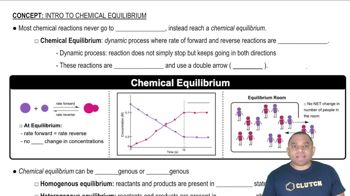
Chemical equilibrium occurs when the rates of the forward and reverse reactions are equal, resulting in constant concentrations of reactants and products. In this case, the equilibrium expression can be used to relate the concentrations of N2O4 and NO2 at a given temperature, allowing for the determination of conditions under which equal amounts of both gases are present.
추천 영상:
가이드 코스
04:21
Chemical Equilibrium Concepts

Gibbs Free Energy

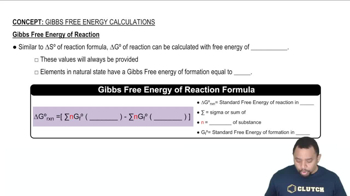
Gibbs Free Energy (G) is a thermodynamic potential that helps predict the direction of chemical reactions and the position of equilibrium. The change in Gibbs Free Energy (ΔG) is related to the enthalpy (ΔH) and entropy (ΔS) of the system, and at equilibrium, ΔG equals zero. This relationship is crucial for determining the temperature at which equal concentrations of N2O4 and NO2 exist.
추천 영상:
가이드 코스
01:51
Gibbs Free Energy of Reactions

Van 't Hoff Equation

The Van 't Hoff equation relates the change in the equilibrium constant (K) of a reaction to the change in temperature. It is expressed as ln(K2/K1) = -ΔH°/R(1/T2 - 1/T1), where R is the gas constant. This equation is essential for calculating the temperature at which the equilibrium concentrations of N2O4 and NO2 are equal, as it allows for the determination of K at different temperatures.
추천 영상:
가이드 코스
01:40
Van der Waals Equation
관련 실천
교과서 질문

The reaction SO2(g) + 2 H2S(g) ⇌ 3 S(s) + 2 H2O(g) is the basis of a suggested method for removal of SO2 from power-plant stack gases. The standard free energy of each substance is given in Appendix C. (b) In principle, is this reaction a feasible method of removing SO2?

420
views
교과서 질문

The reaction SO2(g) + 2 H2S(g) ⇌ 3 S(s) + 2 H2O(g) is the basis of a suggested method for removal of SO2 from power-plant stack gases. The standard free energy of each substance is given in Appendix C. (a) What is the equilibrium constant for the reaction at 298 K? (c) If PSO2 = PH2S and the vapor pressure of water is 25 torr, calculate the equilibrium SO2 pressure in the system at 298 K.

488
views
교과서 질문

The potassium-ion concentration in blood plasma is about 5.0⨉10-3 M, whereas the concentration in muscle-cell fluid is much greater (0.15 M ). The plasma and intracellular fluid are separated by the cell membrane, which we assume is permeable only to K+. (a) What is ΔG for the transfer of 1 mol of K+ from blood plasma to the cellular fluid at body temperature 37 °C? (b) What is the minimum amount of work that must be used to transfer this K+?

1097
views
1
rank
교과서 질문

The reaction SO2(g) + 2 H2S(g) ⇌ 3 S(s) + 2 H2O(g) is the basis of a suggested method for removal of SO2 from power-plant stack gases. The standard free energy of each substance is given in Appendix C. (d) Would you expect the process to be more or less effective at higher temperatures?

339
views
교과서 질문

At what temperatures is the following reaction, the reduction of magnetite by graphite to elemental iron, spontaneous? Fe3O4(s) + 2 C(s, graphite) → 2 CO2(g) + 3 Fe(s)

795
views
1
comments
교과서 질문

The conversion of natural gas, which is mostly methane, into products that contain two or more carbon atoms, such as ethane (C2H6), is a very important industrial chemical process. In principle, methane can be converted into ethane and hydrogen: 2 CH4(g) → C2H6(g) + H2(g) In practice, this reaction is carried out in the presence of oxygen: 2 CH4(g) + 12 O2(g) → C2H6(g) + H2O(g) (b) Is the difference in ΔG° for the two reactions due primarily to the enthalpy term (ΔH) or the entropy term (-TΔS)?

407
views