
Ch.19 - Chemical Thermodynamics
Brown - Chemistry: The Central Science 15th Edition
Brown15th EditionChemistry: The Central ScienceISBN: 9780137542970당신이 사용하는 게 아니라요?교과서 변경
19장, 문제 14d

(d) Does the amount of work that a system can do on its surroundings depend on the path of the process?

검증된 단계별 안내
1
Understand that work is a form of energy transfer that occurs when a force is applied over a distance. In thermodynamics, work done by a system on its surroundings is often related to changes in volume and pressure.
Recognize that the amount of work done by a system can depend on the path taken during a process. This is because work is a path function, not a state function.
Recall that a state function depends only on the initial and final states of a system, not on how the system got from one state to the other. Examples include internal energy, enthalpy, and entropy.
Consider an example: In a pressure-volume (P-V) diagram, the work done by a system during expansion or compression is represented by the area under the curve. Different paths between the same initial and final states can enclose different areas, leading to different amounts of work.
Conclude that because work is a path-dependent function, the amount of work a system can do on its surroundings does indeed depend on the path of the process.

비슷한 문제에 대한 검증된 영상 답변:

이 영상 해법은 위 문제에 도움이 된다고 튜터들이 추천한 것입니다.
영상 길이:
4m
도움이 되었나요?

주요 개념

질문에 올바르게 답하기 위해 반드시 이해해야 하는 핵심 개념들은 다음과 같습니다.

Work in Thermodynamics

In thermodynamics, work is defined as the energy transfer that occurs when a force is applied over a distance. It is a crucial concept because it quantifies the energy changes in a system as it interacts with its surroundings. The work done by or on a system can vary depending on the process it undergoes, which is essential for understanding energy transformations.
추천 영상:
가이드 코스
01:18
First Law of Thermodynamics

Path Dependence

Path dependence refers to the idea that the outcome of a process can vary based on the specific route taken to achieve that outcome. In thermodynamics, certain processes, like work done by a gas during expansion, can depend on whether the expansion is isothermal, adiabatic, or follows another path. This concept is vital for analyzing how different conditions affect the work done by a system.
추천 영상:
가이드 코스
01:24
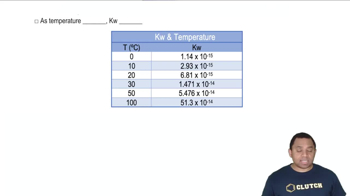
Kw Temperature Dependence

State Functions vs. Path Functions

State functions are properties that depend only on the current state of a system, such as temperature, pressure, and volume, while path functions, like work and heat, depend on the specific process taken to change the state. Understanding this distinction is crucial for answering questions about whether work depends on the path, as it highlights that work is a path function and can vary with different processes.
추천 영상:
가이드 코스
03:37
Logarithmic Functions
관련 실천
교과서 질문

Indicate whether each statement is true or false. (a) A reaction that is spontaneous in one direction will be nonspontaneous in the reverse direction under the same reaction conditions. (b) All spontaneous processes are fast. (c) Most spontaneous processes are reversible. (d) An isothermal process is one in which the system loses no heat. (e) The maximum amount of work can be accomplished by an irreversible process rather than a reversible one.

931
views
교과서 질문

Consider the vaporization of liquid water to steam at a pressure of 1 atm. (b) In what temperature range is it a spontaneous process?

444
views
교과서 질문

Consider the vaporization of liquid water to steam at a pressure of 1 atm. (c) In what temperature range is it a nonspontaneous process?

361
views
교과서 질문

Which of the following processes are spontaneous and which are nonspontaneous: (e) formation of CH4 and O2 molecules from CO2 and H2O at room temperature and 1 atm of pressure?

1390
views
교과서 질문

Consider the vaporization of liquid water to steam at a pressure of 1 atm. (a) Is this process endothermic or exothermic?

655
views
교과서 질문

Which of the following processes are spontaneous?

a. the melting of ice cubes at −10 °C and 1 atm pressure

b. separating a mixture of N2 and O2 into two separate samples, one that is pure N2 and one that is pure O2

c. alignment of iron filings in a magnetic field

d. the reaction of hydrogen gas with oxygen gas to form water vapor at room temperature

e. the dissolution of HCl(g) in water to form concentrated hydrochloric acid

1083
views