
Ch.19 - Chemical Thermodynamics
Brown - Chemistry: The Central Science 15th Edition
Brown15th EditionChemistry: The Central ScienceISBN: 9780137542970당신이 사용하는 게 아니라요?교과서 변경
19장, 문제 85d

(d) For a reversible isothermal process, write an expression for ΔE in terms of q and w and an expression for ΔS in terms of q and T.

검증된 단계별 안내
1
Identify the first law of thermodynamics, which states that the change in internal energy of a system (\(\Delta E\)) is equal to the heat added to the system (q) minus the work done by the system (w). Mathematically, it is expressed as \(\Delta E = q - w\).
Recognize that for a reversible isothermal process, the temperature (T) remains constant. In such processes, any heat added to the system is used to perform work or increase the internal energy.
Write the expression for \(\Delta E\) in terms of q and w for a reversible isothermal process as \(\Delta E = q - w\).
Understand the definition of entropy change (\(\Delta S\)), which is the heat transferred reversibly divided by the temperature at which the transfer occurs. For a reversible process, this is given by \(\Delta S = \frac{q_{\text{rev}}}{T}\).
Write the expression for \(\Delta S\) in terms of q and T for a reversible isothermal process as \(\Delta S = \frac{q}{T}\), where q is the heat involved in the reversible process.

비슷한 문제에 대한 검증된 영상 답변:

이 영상 해법은 위 문제에 도움이 된다고 튜터들이 추천한 것입니다.
영상 길이:
3m
도움이 되었나요?

주요 개념

질문에 올바르게 답하기 위해 반드시 이해해야 하는 핵심 개념들은 다음과 같습니다.

First Law of Thermodynamics

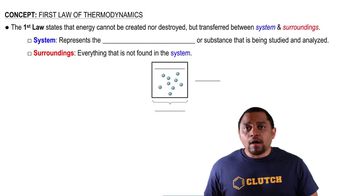
The First Law of Thermodynamics states that energy cannot be created or destroyed, only transformed. In the context of a reversible isothermal process, the change in internal energy (ΔE) is equal to the heat added to the system (q) minus the work done by the system (w). This relationship is crucial for understanding how energy transfers occur in thermodynamic processes.
추천 영상:
가이드 코스
01:18
First Law of Thermodynamics

Isothermal Process

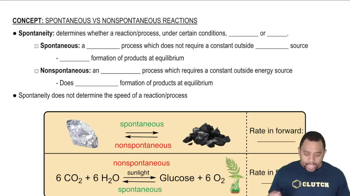
An isothermal process is one that occurs at a constant temperature. During such a process, the internal energy of an ideal gas remains constant, as it is a function of temperature alone. This characteristic allows for the simplification of the relationship between heat (q), work (w), and internal energy (ΔE) in the context of thermodynamic equations.
추천 영상:
가이드 코스
04:20
Spontaneity of Processes

Entropy (ΔS)

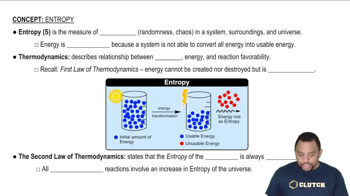
Entropy (ΔS) is a measure of the disorder or randomness in a system. For a reversible isothermal process, the change in entropy can be expressed as ΔS = q/T, where q is the heat exchanged and T is the absolute temperature. This relationship highlights how energy dispersal contributes to the overall disorder of a system, which is a fundamental concept in thermodynamics.
추천 영상:
가이드 코스
02:46
Entropy in Thermodynamics
관련 실천
교과서 질문

For each of the following processes, indicate whether the signs of ΔS and ΔH are expected to be positive, negative, or about zero. (a) A solid sublimes. (b) The temperature of a sample of Co(s) is lowered from 60 °C to 25 °C. (c) Ethyl alcohol evaporates from a beaker. (d) A diatomic molecule dissociates into atoms. (e) A piece of charcoal is combusted to form CO2(g) and H2O(g).

794
views
교과서 질문

The Kb for methylamine (CH3NH2) at 25 °C is given in Appendix D. (d) What is the value of ΔG when [H+] = 6.7 × 10⁻⁹ M, [CH3NH3+] = 2.4 × 10⁻³ M, and [CH3NH2] = 0.098 M?

교과서 질문

The crystalline hydrate Cd(NO3)2⋅4 H2O(s) loses water when placed in a large, closed, dry vessel at room temperature: Cd(NO3)2⋅4 H2O(s) → Cd(NO3)2(s) + 4 H2O(g) This process is spontaneous and ΔH° is positive at room temperature.

(b) If the hydrated compound is placed in a large, closed vessel that already contains a large amount of water vapor, does ΔS° change for this reaction at room temperature?

367
views
교과서 질문

(a) Which of the thermodynamic quantities T, E, q, w, and S are state functions? (b) Which depend on the path taken from one state to another?

568
views
교과서 질문

The Kb for methylamine (CH3NH2) at 25 °C is given in Appendix D. (a) Write the chemical equation for the equilibrium that corresponds to Kb.

610
views
교과서 질문

The crystalline hydrate Cd(NO3)2⋅4 H2O(s) loses water when placed in a large, closed, dry vessel at room temperature: Cd(NO3)2⋅4 H2O(s) → Cd(NO3)2(s) + 4 H2O(g) This process is spontaneous and ΔH° is positive at room temperature.

(a) What is the sign of ΔS° at room temperature?