(a) For a process that occurs at constant temperature, does the change in Gibbs free energy depend on changes in the enthalpy and entropy of the system?
Ch.19 - Chemical Thermodynamics

19장, 문제 48
Predict which member of each of the following pairs has the greater standard entropy at 25°C: (a) C6H6(l) or C6H6(g). Use Appendix C to find the standard entropy of each substance. (b) CO(g) or CO2(g). Use Appendix C to find the standard entropy of each substance. (c) 1 mol N2O4(g) or 2 mol NO2(g). Use Appendix C to find the standard entropy of each substance. (d) HCl(g) or HCl(aq). Use Appendix C to find the standard entropy of each substance.
검증된 단계별 안내1
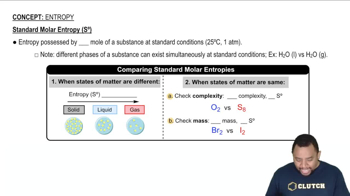
Step 1: Understand the concept of standard entropy. Standard entropy (S°) is a measure of the amount of disorder or randomness in a system at a standard state, typically 1 atm pressure and 25°C. Gases generally have higher entropy than liquids or solids due to greater molecular motion and disorder.
Step 2: For part (a), compare C6H6(l) and C6H6(g). Recognize that the gaseous state (C6H6(g)) will have a higher entropy than the liquid state (C6H6(l)) because gas molecules are more disordered and have more freedom of movement.
Step 3: For part (b), compare CO(g) and CO2(g). Consider the molecular complexity and number of atoms. CO2(g) has more atoms and a more complex structure than CO(g), which generally leads to higher entropy.
Step 4: For part (c), compare 1 mol N2O4(g) and 2 mol NO2(g). Consider the number of moles and molecular complexity. 2 mol NO2(g) will have higher entropy than 1 mol N2O4(g) because there are more moles of gas, leading to greater disorder.
Step 5: For part (d), compare HCl(g) and HCl(aq). Recognize that gases typically have higher entropy than aqueous solutions because gas molecules are more disordered than molecules in solution.
주요 개념
질문에 올바르게 답하기 위해 반드시 이해해야 하는 핵심 개념들은 다음과 같습니다.
Standard Entropy
Standard entropy is a measure of the disorder or randomness of a system at a specified temperature, typically 25°C. It is denoted as S° and is expressed in units of J/(mol·K). Higher entropy values indicate greater disorder, which often correlates with the number of microstates available to a substance. Understanding standard entropy is crucial for predicting the spontaneity of reactions and the behavior of substances in different states.
추천 영상:
가이드 코스
Standard Molar Entropy
Phase Changes and Entropy
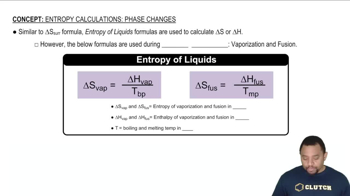
The phase of a substance significantly affects its entropy. Gases generally have higher entropy than liquids and solids due to their greater freedom of movement and higher number of accessible microstates. For example, comparing liquid and gaseous forms of the same substance, the gas will typically exhibit a higher standard entropy. This concept is essential for predicting which member of a pair will have greater entropy based on their physical states.
추천 영상:
가이드 코스
Entropy in Phase Changes
Molecular Complexity and Entropy
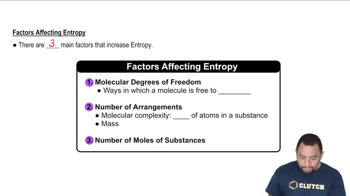
The complexity of a molecule, including its size and the number of atoms, influences its entropy. Larger molecules with more atoms can have more vibrational, rotational, and translational modes, leading to higher entropy values. When comparing different gases or molecular species, understanding how molecular structure affects entropy is vital for making accurate predictions about their standard entropy values.
추천 영상:
가이드 코스
Factors Affecting Entropy
관련 실천
교과서 질문
869
views
교과서 질문
Cyclopropane and propylene are isomers that both have the formula C3H6. Based on the molecular structures shown, which of these isomers would you expect to have the higher standard molar entropy at 25 °C?
2112
views
교과서 질문
Predict the sign of ΔSsys for each of the following processes: (d) Calcium phosphate precipitates upon mixing Ca(NO3)2(aq) and (NH4)3PO4(aq).
551
views
교과서 질문
Using S° values from Appendix C, calculate ΔS° values for the following reactions. In each case, account for the sign of ΔS°.
(a) C2H4(g) + H2(g) → C2H6(g)
(b) N2O4(g) → 2 NO2(g)
(c) Be(OH)2(s) → BeO(s) + H2O(g)
(d) 2 CH3OH(g) + 3 O2(g) ⟶ 2 CO2(g) + 4 H2O(g)
1507
views