Ch.19 - Chemical Thermodynamics
Brown - Chemistry: The Central Science 15th Edition
Brown15th EditionChemistry: The Central ScienceISBN: 9780137542970당신이 사용하는 게 아니라요?교과서 변경
19장, 문제 11d

Which of the following processes are spontaneous and which are nonspontaneous: (d) lightning

검증된 단계별 안내
1
Understand the concept of spontaneity: A spontaneous process occurs without any external intervention, driven by a decrease in free energy (Gibbs free energy, \( \Delta G < 0 \)).
Consider the nature of lightning: Lightning is a natural electrical discharge that occurs in the atmosphere, typically during a thunderstorm.
Analyze the conditions for lightning: It occurs when there is a significant build-up of electrical charge in clouds, leading to a potential difference that exceeds the insulating capacity of the air.
Evaluate the spontaneity: Since lightning occurs naturally and without external intervention once the conditions are met, it is considered a spontaneous process.
Conclude: Lightning is a spontaneous process because it happens naturally under the right atmospheric conditions without any external force.

비슷한 문제에 대한 검증된 영상 답변:

이 영상 해법은 위 문제에 도움이 된다고 튜터들이 추천한 것입니다.
영상 길이:
1m

주요 개념

질문에 올바르게 답하기 위해 반드시 이해해야 하는 핵심 개념들은 다음과 같습니다.

Spontaneity in Chemical Processes

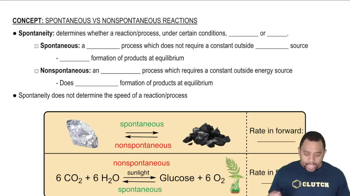
Spontaneity refers to the natural tendency of a process to occur without external intervention. A spontaneous process is one that can proceed in a given direction under specified conditions, often associated with a decrease in free energy. Understanding spontaneity is crucial for predicting whether a reaction or physical change will happen on its own.
추천 영상:
가이드 코스
04:20
Spontaneity of Processes

Thermodynamics and Free Energy

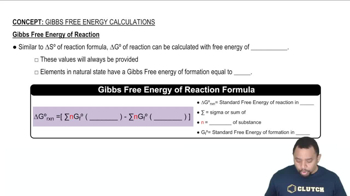
Thermodynamics is the study of energy transformations, and free energy (Gibbs free energy) is a key concept that helps determine spontaneity. A process is spontaneous if it results in a decrease in free energy (ΔG < 0). This principle allows chemists to assess whether a reaction will occur under certain conditions based on energy changes.
추천 영상:
가이드 코스
01:51
Gibbs Free Energy of Reactions

Examples of Spontaneous Processes

Spontaneous processes can include both chemical reactions and physical changes, such as the formation of lightning. Lightning occurs spontaneously due to the buildup of electrical charges in clouds, which eventually discharge when the potential difference is sufficient. Recognizing real-world examples helps illustrate the concept of spontaneity in various contexts.
추천 영상:
가이드 코스
03:05
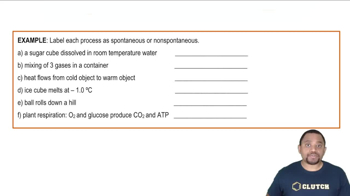
Spontaneity of Processes Example
관련 실천
교과서 질문

Consider a reaction A2(𝑔) + B2(𝑔) ⇌ 2 AB(𝑔), atoms of A shown in red in the diagram and atoms of B shown in blue. (a) If 𝐾𝑐 = 1, which box represents the system at equilibrium?

319
views
교과서 질문

Indicate whether each statement is true or false. (a) A reaction that is spontaneous in one direction will be nonspontaneous in the reverse direction under the same reaction conditions. (b) All spontaneous processes are fast. (c) Most spontaneous processes are reversible. (d) An isothermal process is one in which the system loses no heat. (e) The maximum amount of work can be accomplished by an irreversible process rather than a reversible one.

931
views
교과서 질문

Which of the following processes are spontaneous and which are nonspontaneous: (e) formation of CH4 and O2 molecules from CO2 and H2O at room temperature and 1 atm of pressure?

1390
views
교과서 질문

Which of the following processes are spontaneous?

a. the melting of ice cubes at −10 °C and 1 atm pressure

b. separating a mixture of N2 and O2 into two separate samples, one that is pure N2 and one that is pure O2

c. alignment of iron filings in a magnetic field

d. the reaction of hydrogen gas with oxygen gas to form water vapor at room temperature

e. the dissolution of HCl(g) in water to form concentrated hydrochloric acid

1083
views
교과서 질문

Consider a reaction A2(𝑔) + B2(𝑔) ⇌ 2 AB(𝑔), atoms of A shown in red in the diagram and atoms of B shown in blue. (b) If 𝐾𝑐 = 1, which box represents the system at 𝑄 < 𝐾𝑐?

496
views
교과서 질문

Which of the following processes are spontaneous and which are nonspontaneous: (a) the ripening of a banana

760
views