Ch.2 - Atoms, Molecules, and Ions
Brown - Chemistry: The Central Science 15th Edition
Brown15th EditionChemistry: The Central ScienceISBN: 9780137542970당신이 사용하는 게 아니라요?교과서 변경
2장, 문제 13a3

A chemist finds that 30.82 g of nitrogen will react with 17.60, 35.20, 70.40, or 88.00 g of oxygen to form four different compounds. (a) Calculate the mass of oxygen per gram of nitrogen in each compound. 30.82 g N and 70.40 g O

검증된 단계별 안내
1
Identify the given masses: 30.82 g of nitrogen and 70.40 g of oxygen.
To find the mass of oxygen per gram of nitrogen, divide the mass of oxygen by the mass of nitrogen.
Set up the calculation as follows: \( \text{Mass of oxygen per gram of nitrogen} = \frac{\text{Mass of oxygen}}{\text{Mass of nitrogen}} \).
Substitute the given values into the equation: \( \frac{70.40 \text{ g O}}{30.82 \text{ g N}} \).
Simplify the expression to find the mass of oxygen per gram of nitrogen.

비슷한 문제에 대한 검증된 영상 답변:

이 영상 해법은 위 문제에 도움이 된다고 튜터들이 추천한 것입니다.
영상 길이:
1m
도움이 되었나요?

주요 개념

질문에 올바르게 답하기 위해 반드시 이해해야 하는 핵심 개념들은 다음과 같습니다.

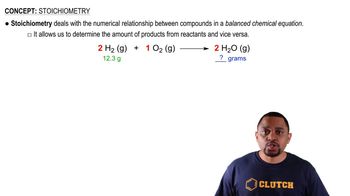
Stoichiometry

Stoichiometry is the branch of chemistry that deals with the quantitative relationships between the reactants and products in a chemical reaction. It allows chemists to calculate the amounts of substances consumed and produced in a reaction based on balanced chemical equations. Understanding stoichiometry is essential for determining the mass ratios of elements in compounds formed from reactions.
추천 영상:
가이드 코스
01:16
Stoichiometry Concept

Mass Ratio

The mass ratio is a comparison of the mass of one substance to the mass of another substance in a chemical reaction. In this context, it refers to the amount of oxygen that reacts with a given mass of nitrogen. Calculating the mass ratio helps in understanding the proportions of elements in different compounds and is crucial for analyzing the results of the chemist's findings.
추천 영상:
가이드 코스
02:14
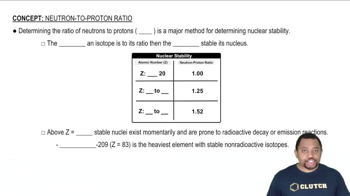
Neutron-Proton Ratio

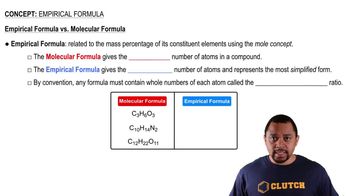
Empirical Formula

The empirical formula represents the simplest whole-number ratio of the elements in a compound. It provides insight into the composition of the compound without detailing the actual number of atoms. By calculating the mass of oxygen per gram of nitrogen, one can derive the empirical formula for the compounds formed, which is important for identifying and classifying the compounds based on their elemental composition.
추천 영상:
가이드 코스
02:26
Empirical vs Molecular Formula
관련 실천
교과서 질문

A chemist finds that 30.82 g of nitrogen will react with 17.60, 35.20, 70.40, or 88.00 g of oxygen to form four different compounds. (b) How do the numbers in part (a) support Dalton's atomic theory?

895
views
교과서 질문

Hydrogen sulfide is composed of two elements: hydrogen and sulfur. In an experiment, 6.500 g of hydrogen sulfide is fully decomposed into its elements. b. What fundamental law does this experiment demonstrate?

6
views

교과서 질문

A chemist finds that 30.82 g of nitrogen will react with 17.60, 35.20, 70.40, or 88.00 g of oxygen to form four different compounds. (a) Calculate the mass of oxygen per gram of nitrogen in each compound. 30.82 g N and 17.60 g O

376
views
교과서 질문

A chemist finds that 30.82 g of nitrogen will react with 17.60, 35.20, 70.40, or 88.00 g of oxygen to form four different compounds. (a) Calculate the mass of oxygen per gram of nitrogen in each compound. 30.82 g N and 35.20 g O

505
views
교과서 질문

A chemist finds that 30.82 g of nitrogen will react with 17.60, 35.20, 70.40, or 88.00 g of oxygen to form four different compounds. (a) Calculate the mass of oxygen per gram of nitrogen in each compound. 30.82 g N and 88.00 g O

1274
views
교과서 질문

A 1.0-g sample of carbon dioxide (CO2) is fully decomposed into its elements, yielding 0.273 g of carbon and 0.727 g of oxygen. If a sample of a different compound decomposes into 0.429 g of carbon and 0.571 g of oxygen, what is its ratio of the mass of O to C? (c) According to Dalton's atomic theory, what is the empirical formula of the second compound?

2001
views