Ch.2 - Atoms, Molecules, and Ions
Brown - Chemistry: The Central Science 15th Edition
Brown15th EditionChemistry: The Central ScienceISBN: 9780137542970당신이 사용하는 게 아니라요?교과서 변경
2장, 문제 5

a. Which of the following diagrams most likely represents an ionic compound?
b. Which of the following diagrams most likely represents a molecular compound?

검증된 단계별 안내
1
1. To identify an ionic compound, look for a diagram that shows a regular, repeating pattern of atoms or ions. This is because ionic compounds form crystal lattices due to the strong electrostatic forces between the positively charged cations and negatively charged anions. The diagram should show a clear pattern of alternating positive and negative charges.
2. To identify a molecular compound, look for a diagram that shows distinct groups of atoms bonded together, but not in a regular, repeating pattern. This is because molecular compounds are made up of individual molecules, each consisting of a fixed number of atoms bonded together in a specific geometric arrangement. The diagram should show distinct groups of atoms, with no clear repeating pattern.

비슷한 문제에 대한 검증된 영상 답변:

이 영상 해법은 위 문제에 도움이 된다고 튜터들이 추천한 것입니다.
영상 길이:
2m
도움이 되었나요?

주요 개념

질문에 올바르게 답하기 위해 반드시 이해해야 하는 핵심 개념들은 다음과 같습니다.

Ionic Compounds

Ionic compounds are formed through the transfer of electrons from one atom to another, resulting in the formation of charged ions. Typically, this occurs between metals and nonmetals, where metals lose electrons to become positively charged cations, and nonmetals gain electrons to become negatively charged anions. The electrostatic attraction between these oppositely charged ions leads to the formation of a crystalline lattice structure, which is characteristic of ionic compounds.
추천 영상:
가이드 코스
02:11
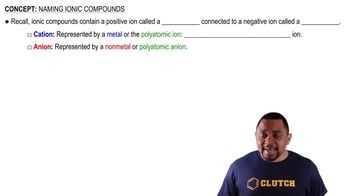
Ionic Compounds Naming

Molecular Compounds

Molecular compounds are formed when two or more nonmetals share electrons through covalent bonds. In these compounds, atoms are held together by the sharing of electron pairs, which allows them to achieve a full outer shell of electrons. Unlike ionic compounds, molecular compounds do not form ions and typically exist as discrete molecules, which can lead to varying physical properties such as lower melting and boiling points compared to ionic compounds.
추천 영상:
가이드 코스
02:06
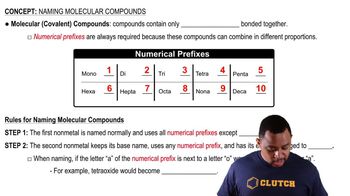
Naming Molecular Compounds

Chemical Diagrams

Chemical diagrams visually represent the structure of compounds, illustrating how atoms are bonded together. For ionic compounds, diagrams often show the transfer of electrons and the resulting ions, while molecular compounds depict shared electron pairs between atoms. Understanding these diagrams is crucial for identifying the type of compound represented, as they highlight the differences in bonding and structure between ionic and molecular substances.
추천 영상:
가이드 코스
01:57
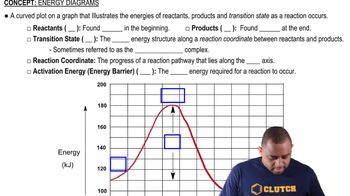
Energy Diagrams