An atom of rhodium (Rh) has a diameter of about 2.7×10⁻⁸ cm. a. What is the radius of a rhodium atom in angstroms (Å) and in meters (m)?
Ch.2 - Atoms, Molecules, and Ions

2장, 문제 21
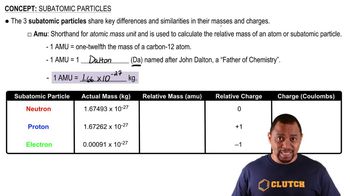
Answer the following questions without referring to Table 2.1: (a) What are the main subatomic particles that make up the atom? (b) What is the relative charge (in multiples of the electronic charge) of each proton? (b) What is the relative charge (in multiples of the electronic charge) of each neutron? (b) What is the relative charge (in multiples of the electronic charge) of each electron? (c) Which of the particles is the most massive? (d) Which is the least massive?
검증된 단계별 안내1
Step 1: Identify the main subatomic particles that make up an atom, which are protons, neutrons, and electrons.
Step 2: Determine the relative charge of a proton. Protons have a positive charge, which is +1 in multiples of the electronic charge.
Step 3: Determine the relative charge of a neutron. Neutrons are neutral, meaning they have a charge of 0 in multiples of the electronic charge.
Step 4: Determine the relative charge of an electron. Electrons have a negative charge, which is -1 in multiples of the electronic charge.
Step 5: Compare the masses of the subatomic particles. Protons and neutrons have similar masses, with neutrons being slightly more massive, while electrons are much less massive than both protons and neutrons.
주요 개념
질문에 올바르게 답하기 위해 반드시 이해해야 하는 핵심 개념들은 다음과 같습니다.
Subatomic Particles
Atoms are composed of three main subatomic particles: protons, neutrons, and electrons. Protons are positively charged particles found in the nucleus, neutrons are neutral particles also located in the nucleus, and electrons are negatively charged particles that orbit the nucleus. Understanding these particles is fundamental to grasping atomic structure and behavior.
추천 영상:
가이드 코스
Subatomic Particles
Relative Charge of Subatomic Particles
The relative charges of subatomic particles are defined in multiples of the elementary charge (e). Protons carry a charge of +1e, neutrons have a charge of 0e, and electrons possess a charge of -1e. This charge distribution is crucial for understanding atomic interactions, bonding, and the overall stability of atoms.
추천 영상:
가이드 코스
Subatomic Particles
Mass of Subatomic Particles
In terms of mass, protons and neutrons are significantly more massive than electrons. A proton has a mass of approximately 1 atomic mass unit (amu), a neutron is slightly heavier at about 1 amu, while an electron has a mass of about 1/1836 amu, making it the least massive of the three. This mass difference plays a key role in the stability and structure of atoms.
추천 영상:
가이드 코스
Subatomic Particles
관련 실천
교과서 질문
2
views
교과서 질문
An atom of rhodium (Rh) has a diameter of about 2.7×10⁻⁸ cm. c. If you assume that the Rh atom is a sphere, what is the volume in m3 of a single atom?
3
views
교과서 질문
The radius of an atom of gold (Au) is about 1.35 Å. c. If the atom is assumed to be a sphere, what is the volume in cm3 of a single Au atom?
1
views
교과서 질문
Determine whether each of the following statements is true or false. a. The nucleus has most of the mass and comprises most of the volume of an atom.
3
views
교과서 질문
Determine whether each of the following statements is true or false. c. The number of electrons in an atom equals the number of neutrons in the atom.
3
views
교과서 질문
Determine whether each of the following statements is true or false. b. Every atom of a given element has the same number of protons.
3
views