Ch.2 - Atoms, Molecules, and Ions
Brown - Chemistry: The Central Science 15th Edition
Brown15th EditionChemistry: The Central ScienceISBN: 9780137542970당신이 사용하는 게 아니라요?교과서 변경
2장, 문제 56

Fill in the gaps in the following table:
Symbol 31P3-
Protons 34 50
Neutrons 45 69 118
Electrons 46 76
Net charge 2- 3+

검증된 단계별 안내
1
Identify the atomic number of each element based on the number of protons. The atomic number is equal to the number of protons.
Determine the number of electrons for each ion by considering the net charge. For a neutral atom, the number of electrons equals the number of protons. Adjust the electron count based on the net charge: add electrons for negative charges and subtract for positive charges.
Calculate the mass number for each isotope by adding the number of protons and neutrons. The mass number is the sum of protons and neutrons.
Use the symbol notation for each isotope, which is typically written as \( ^{A}_{Z}X^{charge} \), where \( A \) is the mass number, \( Z \) is the atomic number, and \( X \) is the element symbol.
Fill in the missing values in the table using the information derived from the above steps.

비슷한 문제에 대한 검증된 영상 답변:

이 영상 해법은 위 문제에 도움이 된다고 튜터들이 추천한 것입니다.
영상 길이:
6m

주요 개념

질문에 올바르게 답하기 위해 반드시 이해해야 하는 핵심 개념들은 다음과 같습니다.

Atomic Structure

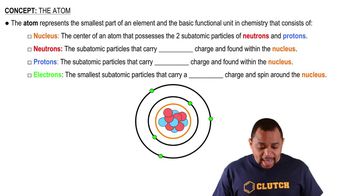
Atomic structure refers to the composition of an atom, which includes protons, neutrons, and electrons. Protons are positively charged particles found in the nucleus, while neutrons are neutral particles also located in the nucleus. Electrons are negatively charged and orbit the nucleus. Understanding the arrangement and number of these subatomic particles is crucial for determining the identity and properties of an element.
추천 영상:

Ionic Charge

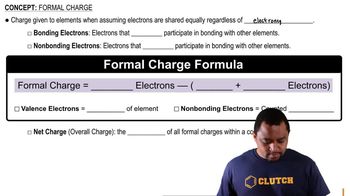
Ionic charge is the electrical charge that an atom or molecule carries due to the loss or gain of electrons. An atom that loses electrons becomes positively charged (cation), while one that gains electrons becomes negatively charged (anion). The net charge of an ion is essential for understanding its behavior in chemical reactions and interactions, as it influences how ions combine to form compounds.
추천 영상:

Isotopes

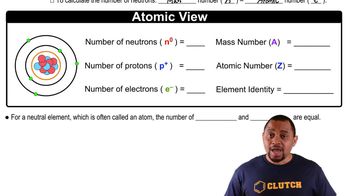
Isotopes are variants of a particular chemical element that have the same number of protons but different numbers of neutrons. This results in different atomic masses for the isotopes of the same element. Isotopes can be stable or unstable (radioactive), and their existence is important in various applications, including dating archaeological finds and medical diagnostics.
추천 영상: