Ch.2 - Atoms, Molecules, and Ions
Brown - Chemistry: The Central Science 15th Edition
Brown15th EditionChemistry: The Central ScienceISBN: 9780137542970당신이 사용하는 게 아니라요?교과서 변경
2장, 문제 65e

Predict whether each of the following compounds is molecular or ionic: (e) CsBr

검증된 단계별 안내
1
Identify the elements in the compound CsBr: Cesium (Cs) and Bromine (Br).
Determine the type of elements: Cesium (Cs) is a metal, and Bromine (Br) is a non-metal.
Recall that ionic compounds are typically formed between metals and non-metals.
Consider the position of Cesium in the periodic table: it is an alkali metal, which are known to form ionic compounds.
Conclude that CsBr is likely an ionic compound because it consists of a metal and a non-metal.

비슷한 문제에 대한 검증된 영상 답변:

이 영상 해법은 위 문제에 도움이 된다고 튜터들이 추천한 것입니다.
영상 길이:
3m
도움이 되었나요?

주요 개념

질문에 올바르게 답하기 위해 반드시 이해해야 하는 핵심 개념들은 다음과 같습니다.

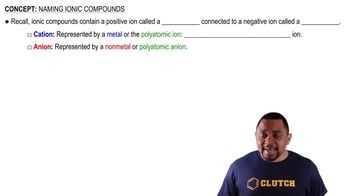
Ionic Compounds

Ionic compounds are formed when atoms transfer electrons, resulting in the formation of charged ions. Typically, these compounds consist of a metal and a non-metal, where the metal loses electrons to become a positively charged cation, and the non-metal gains electrons to become a negatively charged anion. The electrostatic attraction between these oppositely charged ions leads to the formation of a crystalline lattice structure.
추천 영상:
가이드 코스
02:11
Ionic Compounds Naming

Molecular Compounds

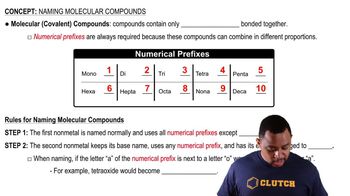
Molecular compounds are formed when two or more non-metal atoms share electrons through covalent bonds. These compounds consist of discrete molecules, where the atoms are held together by shared pairs of electrons. Unlike ionic compounds, molecular compounds generally have lower melting and boiling points and do not conduct electricity in solution.
추천 영상:
가이드 코스
02:06
Naming Molecular Compounds

Periodic Table Trends

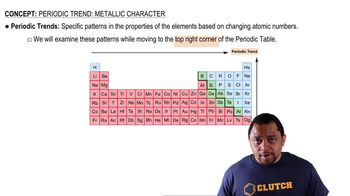
The periodic table organizes elements based on their atomic number and properties, revealing trends in reactivity, electronegativity, and ionization energy. Elements on the left side, such as alkali metals, tend to lose electrons easily, forming cations, while elements on the right side, such as halogens, tend to gain electrons, forming anions. Understanding these trends helps predict whether a compound will be ionic or molecular based on the types of elements involved.
추천 영상:
가이드 코스
00:38
Periodic Trends