
Ch.2 - Atoms, Molecules, and Ions
Brown - Chemistry: The Central Science 15th Edition
Brown15th EditionChemistry: The Central ScienceISBN: 9780137542970당신이 사용하는 게 아니라요?교과서 변경
2장, 문제 97a

The element oxygen has three naturally occurring isotopes, with 8, 9, and 10 neutrons in the nucleus, respectively. a. Write the full chemical symbols for these three isotopes.

검증된 단계별 안내
1
insert step 1: Understand that the chemical symbol for oxygen is 'O' and its atomic number is 8, which means it has 8 protons.
insert step 2: Recall that the full chemical symbol for an isotope is written as \( ^A_Z \text{X} \), where \( A \) is the mass number (sum of protons and neutrons), \( Z \) is the atomic number (number of protons), and \( \text{X} \) is the chemical symbol.
insert step 3: For the first isotope with 8 neutrons, calculate the mass number: \( A = 8 \text{ (protons)} + 8 \text{ (neutrons)} = 16 \). The full chemical symbol is \( ^{16}_8 \text{O} \).
insert step 4: For the second isotope with 9 neutrons, calculate the mass number: \( A = 8 \text{ (protons)} + 9 \text{ (neutrons)} = 17 \). The full chemical symbol is \( ^{17}_8 \text{O} \).
insert step 5: For the third isotope with 10 neutrons, calculate the mass number: \( A = 8 \text{ (protons)} + 10 \text{ (neutrons)} = 18 \). The full chemical symbol is \( ^{18}_8 \text{O} \).

비슷한 문제에 대한 검증된 영상 답변:

이 영상 해법은 위 문제에 도움이 된다고 튜터들이 추천한 것입니다.
영상 길이:
2m
도움이 되었나요?

주요 개념

질문에 올바르게 답하기 위해 반드시 이해해야 하는 핵심 개념들은 다음과 같습니다.

Isotopes

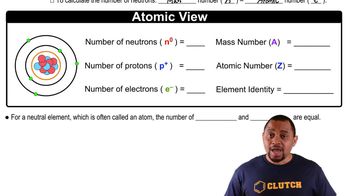
Isotopes are variants of a chemical element that have the same number of protons but different numbers of neutrons in their nuclei. This difference in neutron count results in varying atomic masses for the isotopes. For example, oxygen has three isotopes: oxygen-16, oxygen-17, and oxygen-18, corresponding to 8, 9, and 10 neutrons, respectively.
추천 영상:

Chemical Symbols

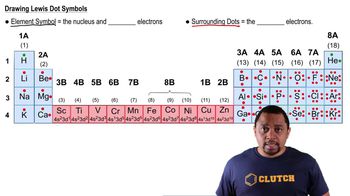
Chemical symbols are shorthand representations of elements and their isotopes, consisting of one or two letters derived from their English or Latin names. The full chemical symbol for an isotope includes the element's symbol, the mass number (total protons and neutrons) as a superscript, and the atomic number (number of protons) as a subscript. For oxygen isotopes, the symbols are written as ¹⁶O, ¹⁷O, and ¹⁸O.
추천 영상:
가이드 코스
03:17
Lewis Dot Symbols

Mass Number

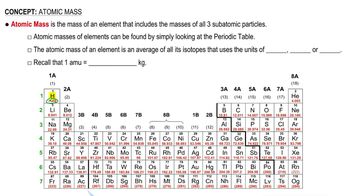
The mass number of an isotope is the total count of protons and neutrons in its nucleus. It is crucial for distinguishing between different isotopes of the same element. For instance, the mass numbers of the oxygen isotopes are 16, 17, and 18, reflecting their respective neutron counts when combined with the constant number of protons (8) in oxygen.
추천 영상:
관련 실천
교과서 질문

Gallium (Ga) consists of two naturally occurring isotopes with masses of 68.926 and 70.925 amu. a. How many protons and neutrons are in the nucleus of each isotope? Write the complete atomic symbol for each, showing the atomic number and mass number. b. The average atomic mass of Ga is 69.72 amu. Calculate the abundance of each isotope.

2
views
교과서 질문

Identify the element represented by each of the following symbols and give the number of protons and neutrons in each: (a) 7433X

830
views
교과서 질문

The nucleus of 6Li is a powerful absorber of neutrons. It exists in the naturally occurring metal to the extent of 7.5%. In the era of nuclear deterrence, large quantities of lithium were processed to remove 6Li for use in hydrogen bomb production. The lithium metal remaining after removal of 6Li was sold on the market. (b) The atomic masses of 6Li and 7Li are 6.015122 and 7.016004 u, respectively. A sample of lithium depleted in the lighter isotope was found on analysis to contain 1.442% 6Li. What is the average atomic weight of this sample of the metal?

935
views
교과서 질문

There are two different isotopes of bromine atoms. Under normal conditions, elemental bromine consists of molecules, and the mass of a molecule is the sum of the masses of the two atoms in the molecule. The mass spectrum of consists of three peaks: m/zRelative Peak Intensity157.836 0.2569 159.834 0.4999 161.832 0.2431

a. What is the origin of each peak (of what isotopes does each consist)?

3
views
교과서 질문

The element lead (Pb) consists of four naturally occurring isotopes with atomic masses 203.97302, 205.97444, 206.97587, and 207.97663 amu. The relative abundances of these four isotopes are 1.4, 24.1, 22.1, and 52.4%, respectively. From these data, calculate the atomic weight of lead.

2
views
교과서 질문

Identify the element represented by each of the following symbols and give the number of protons and neutrons in each: (b) 12753X (c) 8636X (d) 6730X

520
views