Ch.2 - Atoms, Molecules, and Ions
Brown - Chemistry: The Central Science 15th Edition
Brown15th EditionChemistry: The Central ScienceISBN: 9780137542970당신이 사용하는 게 아니라요?교과서 변경
2장, 문제 44

The elements of Group 14 show an interesting change in properties moving down the group. Give the name and chemical symbol of each element in the group and label it as a nonmetal, metalloid, or metal.

검증된 단계별 안내
1
Step 1: Identify the elements in Group 14 of the periodic table. These elements are carbon (C), silicon (Si), germanium (Ge), tin (Sn), and lead (Pb).
Step 2: Classify carbon (C). Carbon is a nonmetal, known for its ability to form a wide variety of compounds, including organic molecules.
Step 3: Classify silicon (Si) and germanium (Ge). Both silicon and germanium are metalloids, which means they have properties intermediate between metals and nonmetals.
Step 4: Classify tin (Sn). Tin is a metal, known for its malleability and use in alloys such as bronze.
Step 5: Classify lead (Pb). Lead is also a metal, recognized for its density and use in applications like batteries and radiation shielding.

주요 개념

질문에 올바르게 답하기 위해 반드시 이해해야 하는 핵심 개념들은 다음과 같습니다.

Group 14 Elements

Group 14 of the periodic table, also known as the carbon group, includes the elements carbon (C), silicon (Si), germanium (Ge), tin (Sn), lead (Pb), and flerovium (Fl). These elements exhibit a range of properties that change from nonmetals to metals as you move down the group, influencing their chemical behavior and applications.
추천 영상:
가이드 코스
00:50
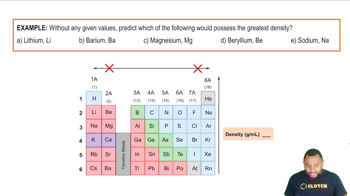
Main Group Elements: Density Example

Classification of Elements

Elements can be classified as metals, nonmetals, or metalloids based on their physical and chemical properties. Nonmetals, like carbon, are typically poor conductors of heat and electricity, while metals, such as tin and lead, are good conductors and malleable. Metalloids, like silicon and germanium, possess properties intermediate between metals and nonmetals.
추천 영상:
가이드 코스
01:39
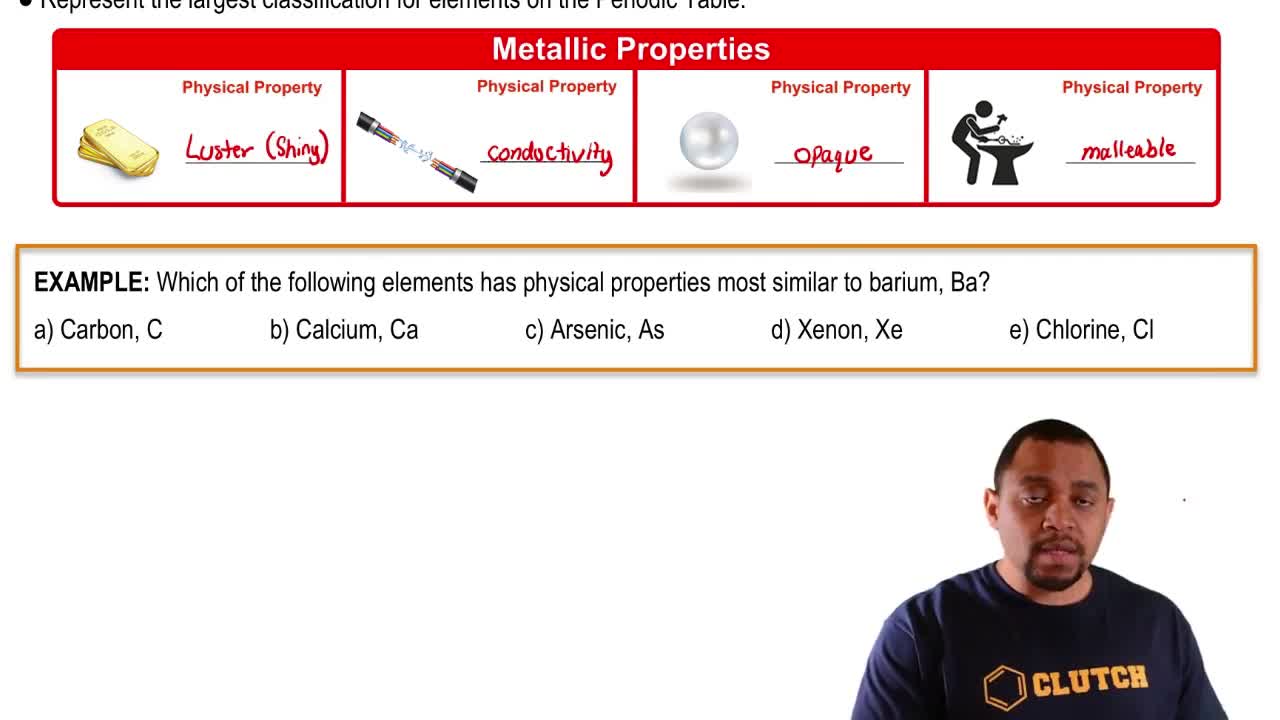
Element Classification Example

Trends in the Periodic Table

As you move down a group in the periodic table, elements generally exhibit trends such as increasing atomic size, decreasing ionization energy, and varying electronegativity. These trends affect the reactivity and bonding characteristics of the elements, leading to the observed changes in properties within Group 14.
추천 영상:
가이드 코스
00:38
Periodic Trends
관련 실천
교과서 질문

The structural formulas of the compounds n-butane and isobutane are shown below. (c) Which formulas—empirical, molecular, or structural—allow you determine these are different compounds?

605
views

교과서 질문

The structural formulas of the compounds n-butane and isobutane are shown below. (b) Determine the empirical formula of each.

815
views
교과서 질문

For each of the following elements, write its chemical symbol, locate it in the periodic table, give its atomic number, and indicate whether it is a metal, metalloid, or nonmetal: (a) radon (b) tellurium (c) cadmium (d) chromium (e) barium (f) selenium (g) arsenic.

1150
views
교과서 질문

For each of the following elements, write its chemical symbol, determine the name of the group to which it belongs (Table 2.3), and indicate whether it is a metal, metalloid, or nonmetal: (a) polonium (b) strontium (c) neon (d) rubidium (e) sulfur.

603
views
교과서 질문

Massspectrometry is more often applied to molecules than to atoms. We will see in Chapter 3 that the molecular weight of a molecule is the sum of the atomic weights of the atoms in the molecule. The mass spectrum of H2 is taken under conditions that prevent decomposition into H atoms. The two naturally occurring isotopes of hydrogen are 1H (atomic mass = 1.00783 amu; abundance 99.9885%) and 2H (atomic mass = 2.01410; abundance 0.0115%). (c) Which peak will be the largest, and which the smallest?

1035
views
교과서 질문

Ball-and-stick representations of benzene, a colorless liquid often used in organic chemistry reactions, and acetylene, a gas used as a fuel for high-temperature welding, are shown below. (a) Determine the molecular formula of each.

427
views