Ch.2 - Atoms, Molecules, and Ions
Brown - Chemistry: The Central Science 15th Edition
Brown15th EditionChemistry: The Central ScienceISBN: 9780137542970당신이 사용하는 게 아니라요?교과서 변경
2장, 문제 31d

Write the correct symbol, with both superscript and subscript, for each of the following. Use the list of elements in the front inside cover as needed: (d) the isotope of magnesium that has an equal number of protons and neutrons.

검증된 단계별 안내
1
insert step 1> Identify the atomic number of magnesium from the periodic table, which is 12. This means magnesium has 12 protons.
insert step 2> Since the problem states that the isotope has an equal number of protons and neutrons, the number of neutrons is also 12.
insert step 3> Calculate the mass number of the isotope by adding the number of protons and neutrons: Mass number = 12 (protons) + 12 (neutrons) = 24.
insert step 4> Write the isotope symbol for magnesium, which includes the element symbol (Mg), the mass number as a superscript, and the atomic number as a subscript.
insert step 5> The correct isotope symbol for magnesium with equal protons and neutrons is \(^{24}_{12}\text{Mg}\).

비슷한 문제에 대한 검증된 영상 답변:

이 영상 해법은 위 문제에 도움이 된다고 튜터들이 추천한 것입니다.
영상 길이:
2m
도움이 되었나요?

주요 개념

질문에 올바르게 답하기 위해 반드시 이해해야 하는 핵심 개념들은 다음과 같습니다.

Isotopes

Isotopes are variants of a chemical element that have the same number of protons but different numbers of neutrons. This means they share the same atomic number but have different atomic masses. For example, magnesium has several isotopes, including magnesium-24, which has 12 protons and 12 neutrons.
추천 영상:

Atomic Notation

Atomic notation is a way to represent elements and their isotopes using symbols that include the element's chemical symbol, the atomic number (number of protons), and the mass number (total number of protons and neutrons). The mass number is written as a superscript and the atomic number as a subscript. For magnesium-24, it is represented as ²⁴₁₂Mg.
추천 영상:
가이드 코스
02:50
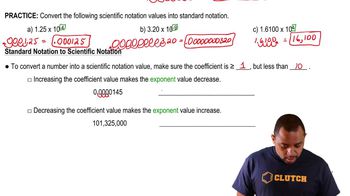
Standard Notation to Scientific Notation

Protons and Neutrons

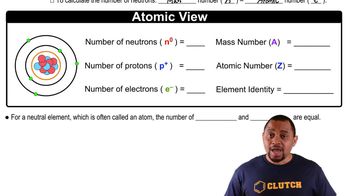
Protons and neutrons are subatomic particles found in the nucleus of an atom. Protons carry a positive charge and determine the element's identity, while neutrons are neutral and contribute to the atomic mass. The number of protons defines the atomic number, and in isotopes, the number of neutrons can vary, affecting the stability and properties of the element.
추천 영상:
가이드 코스
01:38
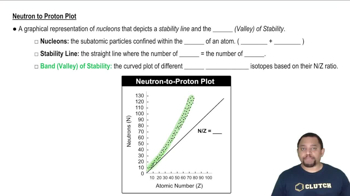
Neutron-to-Proton Plot
관련 실천
교과서 질문

Write the correct symbol, with both superscript and subscript, for each of the following. Use the list of elements in the front inside cover as needed: (a) the isotope of platinum that contains 118 neutrons

816
views

교과서 질문

Write the correct symbol, with both superscript and subscript, for each of the following. Use the list of elements in the front inside cover as needed: (b) the isotope of krypton with mass number 84 (c) the isotope of rhenium with mass number 187

977
views
교과서 질문

Only two isotopes of copper occur naturally: 63Cu (atomic mass = 62.9296 amu; abundance 69.17%) 65Cu (atomic mass = 64.9278 amu; abundance 30.83%). Calculate the atomic weight (average atomic mass) of copper.

4359
views
교과서 질문

The atomic weight of boron is reported as 10.81, yet no atom of boron has the mass of 10.81 amu. Which is the best explanation?

a. The measurement of atomic mass is only reliable to two significant figures.

b. The atomic weight is an average of many individual atoms.

c. The atomic weight is an average of many isotopes of the same nuclear composition.

교과서 질문

(b) Why is the atomic weight of carbon reported as 12.011 in the table of elements and the periodic table in the front inside cover of this text?

1408
views
교과서 질문

Fill in the gaps in the following table, assuming each column represents a neutral atom.

Symbol 112Cd

Protons 38 92

Neutrons 58 49

Electrons 38 36

Mass no. 81 235

Complete the third row of the table.

Complete the fourth row of the table.

636
views