Ch.20 - Electrochemistry
Brown - Chemistry: The Central Science 15th Edition
Brown15th EditionChemistry: The Central ScienceISBN: 9780137542970당신이 사용하는 게 아니라요?교과서 변경
20장, 문제 45

A 1 M solution of Cu(NO3)2 is placed in a beaker with a strip of Cu metal. A 1 M solution of SnSO4 is placed in a second beaker with a strip of Sn metal. A salt bridge connects the two beakers, and wires to a voltmeter link the two metal electrodes. (a) Which electrode serves as the anode, and which as the cathode? (b) Which electrode gains mass, and which loses mass as the cell reaction proceeds?

검증된 단계별 안내
1
Identify the half-reactions for each metal in the electrochemical cell. Copper (Cu) and tin (Sn) are involved in redox reactions. Write the reduction half-reaction for Cu: \( \text{Cu}^{2+} + 2e^- \rightarrow \text{Cu} \) and for Sn: \( \text{Sn}^{2+} + 2e^- \rightarrow \text{Sn} \).
Determine the standard reduction potentials for each half-reaction. The standard reduction potential for Cu is +0.34 V, and for Sn, it is -0.14 V. Compare these values to determine which metal is more likely to be reduced.
Identify the anode and cathode based on the reduction potentials. The electrode with the higher reduction potential will be the cathode (where reduction occurs), and the electrode with the lower reduction potential will be the anode (where oxidation occurs).
Determine which electrode gains mass and which loses mass. At the cathode, reduction occurs, leading to the deposition of metal ions onto the electrode, increasing its mass. At the anode, oxidation occurs, causing the metal to dissolve into ions, decreasing its mass.
Summarize the findings: The electrode with the higher reduction potential (Cu) serves as the cathode and gains mass, while the electrode with the lower reduction potential (Sn) serves as the anode and loses mass.

주요 개념

질문에 올바르게 답하기 위해 반드시 이해해야 하는 핵심 개념들은 다음과 같습니다.

Electrochemical Cells

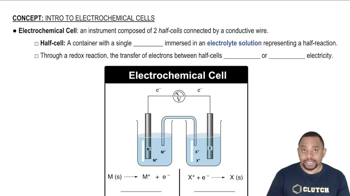
Electrochemical cells consist of two electrodes, an anode and a cathode, where oxidation and reduction reactions occur. The anode is where oxidation takes place, leading to the loss of electrons, while the cathode is where reduction occurs, resulting in the gain of electrons. In this setup, the flow of electrons from the anode to the cathode generates an electric current, which can be measured with a voltmeter.
추천 영상:
가이드 코스
02:46
Electrochemical Cells

Oxidation and Reduction

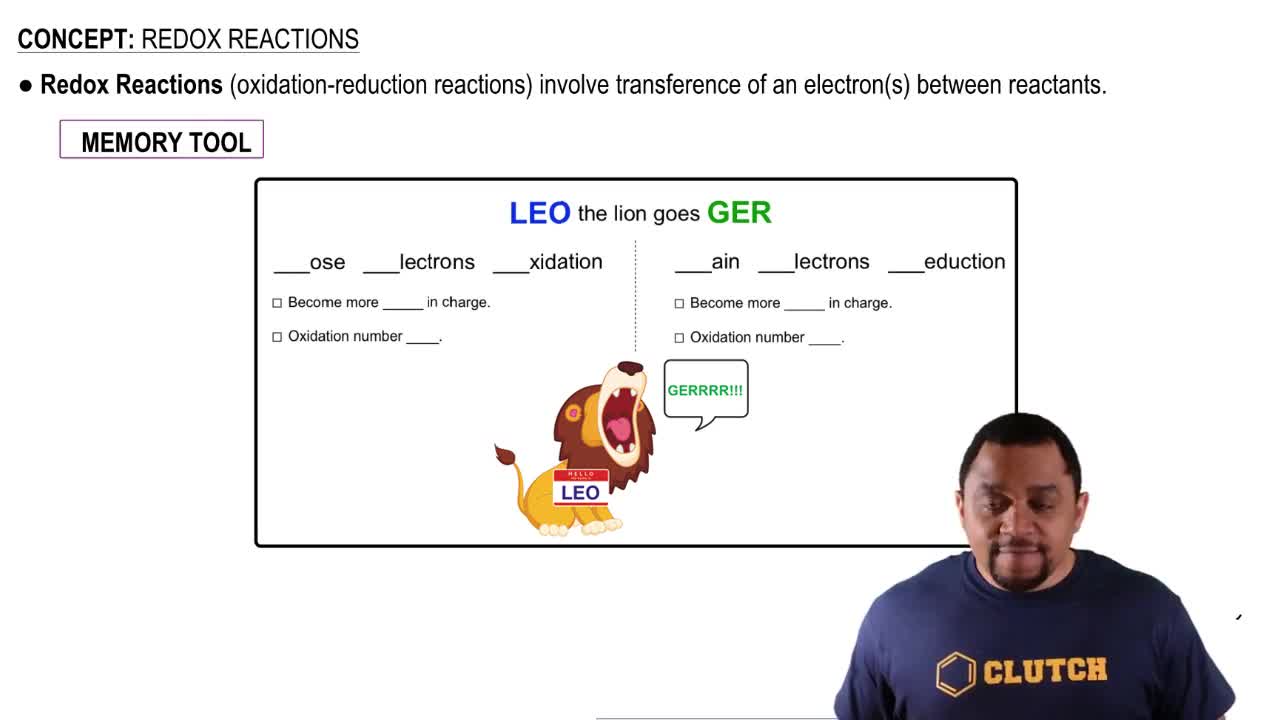
Oxidation is defined as the loss of electrons, while reduction is the gain of electrons. In the context of the given question, copper (Cu) and tin (Sn) are involved in redox reactions. The metal that is oxidized will lose mass as it dissolves into the solution, while the metal that is reduced will gain mass as it deposits from the solution onto the electrode.
추천 영상:
가이드 코스
01:53
Oxidation and Reduction Reactions

Salt Bridge Function

A salt bridge is a crucial component of electrochemical cells that maintains electrical neutrality by allowing the flow of ions between the two half-cells. It prevents the solutions from mixing while enabling the movement of ions to balance the charge as oxidation and reduction reactions occur. This balance is essential for the continuous operation of the cell and affects the overall cell potential.
추천 영상: