
A voltaic cell utilizes the following reaction: 4 Fe2+1aq2 + O21g2 + 4 H+1aq2 ¡ 4 Fe3+1aq2 + 2 H2O1l2 (b) What is the emf of this cell when 3Fe2+4 = 1.3 M, 3Fe3+4= 0.010 M, PO2 = 0.50 atm, and the pH of the solution in the cathode half-cell is 3.50?
Ch.20 - Electrochemistry

20장, 문제 72a
A voltaic cell utilizes the following reaction: 2 Fe3+1aq2 + H21g2 ¡ 2 Fe2+1aq2 + 2 H+1aq2 (a) What is the emf of this cell under standard conditions?
검증된 단계별 안내1
Step 1: Identify the half-reactions involved in the overall cell reaction.
Step 2: Write the reduction half-reaction and the oxidation half-reaction separately.
Step 3: Use the standard reduction potentials from a table to find the potential for each half-reaction.
Step 4: Calculate the standard cell potential (emf) by subtracting the oxidation potential from the reduction potential.
Step 5: Ensure the units are consistent and the final expression is in volts (V).

비슷한 문제에 대한 검증된 영상 답변:
이 영상 해법은 위 문제에 도움이 된다고 튜터들이 추천한 것입니다.
영상 길이:
4m도움이 되었나요?
주요 개념
질문에 올바르게 답하기 위해 반드시 이해해야 하는 핵심 개념들은 다음과 같습니다.
Electrochemical Cells
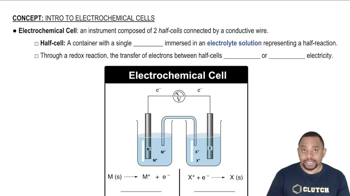
Electrochemical cells are devices that convert chemical energy into electrical energy through redox reactions. A voltaic cell, specifically, generates electricity spontaneously from a chemical reaction, involving oxidation and reduction processes occurring in separate half-cells. Understanding the structure and function of these cells is essential for analyzing their emf (electromotive force) and overall efficiency.
추천 영상:
가이드 코스
Electrochemical Cells
Standard Electrode Potentials
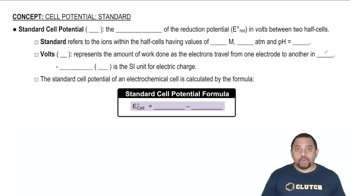
Standard electrode potentials are measured voltages that indicate the tendency of a species to be reduced, measured under standard conditions (1 M concentration, 1 atm pressure, and 25°C). Each half-reaction in a voltaic cell has a specific standard electrode potential, which can be used to calculate the overall cell potential (emf) by subtracting the anode potential from the cathode potential. This concept is crucial for determining the emf of the cell in the given reaction.
추천 영상:
가이드 코스
Standard Cell Potential
Nernst Equation
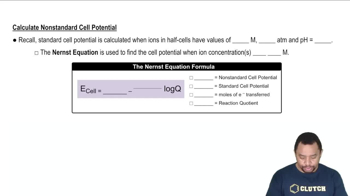
The Nernst equation relates the emf of an electrochemical cell to the concentrations of the reactants and products involved in the redox reaction. It allows for the calculation of the cell potential under non-standard conditions, taking into account temperature and concentration variations. Understanding this equation is important for predicting how the emf changes as the reaction progresses or as conditions vary.
추천 영상:
가이드 코스
The Nernst Equation
관련 실천
교과서 질문
742
views
교과서 질문
A voltaic cell is constructed that is based on the following reaction: Sn2+(aq) + Pb(s) → Sn(s) + Pb2+(aq) (a) If the concentration of Sn2+ in the cathode half-cell is 1.00 M and the cell generates an emf of +0.22 V, what is the concentration of Pb2+ in the anode half-cell?
936
views
교과서 질문
A voltaic cell utilizes the following reaction: (b) What is the emf for this cell when 3Fe3+4 = 3.50 M, PH2= 0.95 atm, 3Fe2+4 = 0.0010 M, and the pH in both half-cells is 4.00?
1012
views
1
comments
교과서 질문
A voltaic cell utilizes the following reaction: 4 Fe2+1aq2 + O21g2 + 4 H+1aq2 ¡ 4 Fe3+1aq2 + 2 H2O1l2 (a) What is the emf of this cell under standard conditions?
398
views
